Pages

Saturday, March 31, 2012

Whats In a Name? More Than You'd Think...


           I suck at naming characters. Which is ironic, because I’m working on at least 2 long-term stories which will require me to come up with unique naming conventions for multiple societies, all from scratch. Yay me. But because I apparently hate myself and want to do as much work as possible, I’ve been forced to get friendly with a lot of tips and tidbits which have helped me out over the arduous process of storycrafting, and I’m going to lay ‘em down now.


Names are important. So it turns out Shakespeare didn’t know jack shit. Although names might seem like simple labels for telling people apart, they can be useful tools for establishing character on a first impression. Think about it: if you read the names “Blinnie” and “Warchester”, chances are you have two completely different mental images of them based on the sound of their name alone. This isn’t coincidental, and should be exploited to the full extent of your ability. Also I was joking about the Shakespeare thing; please don’t let his angry ghost rise up and suck my brains out through my eyeballs. I’m sure that would give good ‘ole Edgar Allen’s ghost a boner. A Poener, if you will. (And thus, the comedy on this blog stoops to a whole new low. I regret nothing.)

Friday, March 30, 2012

Ladies, Gentlemen, and Mad Men


        Today we have a new guest writer by the interblag name of SnowGhost, who is here to talk about Mad Men and guilt me into watching it. JUST LEAVE ME ALONE TO MY 30 ROCK MARATHONS AND THE CREEPING REALIZATION THAT I AM A YOUNGER LIZ LEMON. 


          It’s that time again. Grab your favourite three piece suit or blouse and a nice cold glass of whiskey on the rocks; Mad Men is back on AMC. The two hour premiere debuted last Sunday and before I get into how I felt about it I'm going to discuss the show itself, because I’m dying to spread my knowledge to anyone at this point.

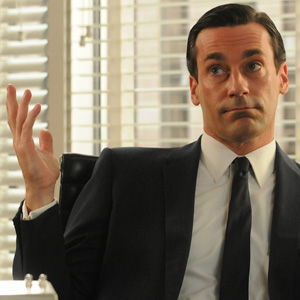
            Mad Men takes place in 60s America as we follow the life of protagonist Don Draper (Played by Jon Hamm), a chief writer for Sterling Cooper Advertising Agency. He has a lovely wife Betty (played by January Jones, aka Emma Frost from First Class) and two loving children with a nice house and even a black[1] help. He’s friends with Roger Sterling, one of the chairmen of the company, and they go drinking every so often. From the looks of it, Don has it all. He’s literally living the American dream - but if only that was the truth. And boy oh boy how far from it is it.

What you call love was invented by guys like me, to sell nylons. You're born alone and you die alone and this world just drops a bunch of rules on top of you to make you forget those facts. But I never forget. I'm living like there's no tomorrow, because there isn't one.–Don Draper

            When your main character follows a philosophy like that, you know things aren’t as good as he’d like. He’s a cynic, reminiscent of characters played by Humphrey Bogart. He’s also a massive playboy and an affair means absolutely nothing to him so long as he can get away with it. In many cases this makes a character unlikeable, but he’s just so charming that you forget every reason you’d normally hate his guts. And that’s what makes the show so wonderful. The characters are not nice people by any stretch but we become invested in their plights. Ranging from the seductive Joan (played by Christina Hendricks, that one chick who showed up for two episodes in Firefly and for a few minutes in Drive) to the jealous Pete Campbell, to the talented Ken Cosgrove (Aaron Stanton, easily recognized as Cole Phelps from L.A Noire: seriously everyone is a face someone has seen one way or another).

            To say the show is good is an understatement. It won the Emmy for best drama four times in a row. Let me just say that again. Four times in a fucking row, beating out the likes of Dexter, Lost, House, Breaking Bad, Boardwalk Empire and Game of Thrones. It’s also gotten a lot of critical praise for its historical accuracy in terms of racial issues, sexism, alcoholism and smoking and it doesn’t shy away from these themes. This is the 60s, the good, the bad and the worst of it. Honestly, ask yourself, why you aren’t watching this right now? (Seriously Jenkins, watch this. And Luther. And Breaking Bad. And The Walking Dead S2. Argh, get it together)


            It’ll take you three episodes to decide whether or not you’re hooked or not. But once you’re on board, the train doesn’t stop. It slows down, it speeds up and twists, turns and loops, but it never stops and while I could praise this show to the highest of high heavens, I have to say that the series does stumble a bit. Some episodes feel extremely slow and others feel highly unnecessary and pointless. Certain characters don’t get much screen time while others seem to get too much. With a cast this wide, it’s hard to divide the time amongst them but it’s one of the flaws that Mad Men has yet to really fix. Also the show does come across as melodramatic to the point of annoyance. On the other hand, it has Christian Hendricks in lovely dresses. You can’t lose with that, I guess. There’s also a lot of Jon Hamm, shirtless in all of his manly glory. Mad Men has something for everyone it seems. So stop complaining about Mass Effect 3, waiting for season four of Arrested Development or debating whether or not The Hunger Games is a good film and just give it a try.

            Oh. And as for the season 5 premiere, it was a brilliant and well done episode. But after finding out the show won the Best Drama four times in a row, did you need to me to say that? As the episode rolled on, the smile on my face got bigger and bigger as they pushed a new subject matter to the forefront. Civil rights have finally caught wind in New York and it’s going to set up interesting plotlines for the rest of the season. Another thing that needs to be brought up is that Don has changed. He’s less cynical, he’s got a smile on, and he seems to be a bit easier to talk to. The truth is, ever since the previous events of Season 4, Don may have, in fact, maybe, possibly, gotten happy with his life. It’s a strong contrast to his character in the previous season as we saw Don hit a low. Outside of Don, everyone hasn’t seemed to have changed. Pete is still snide and jealous, Harry is still awkward, Roger is still the coy bastard (albeit a bit more envious), Lane is still British, and Joan -- seeing some new changes in her life -- still hasn’t adjusted to many of the events that occurred. The premiere was a wonderful episode and one that leaves me excited for what Matthew Weiner (series creator) has to offer in the future. 

            It’s good to be back in the office. (No, not that office)


Picture References
http://xfinity.comcast.net/blogs/tv/files/2011/03/don-draper-mad-men.jpg
http://images1.fanpop.com/images/photos/1400000/Michael-in-Branch-Closing-michael-scott-1468603-1280-720.jpg

Thursday, March 29, 2012

Not Feeling The Love

StarGazer

 ****WARNING: Contains spoilers for Fringe.****

            The FOX TV show Fringe recently returned from a month-long hiatus with the episode “A Short Story about Love”. Without going into too much depth about the details of the story, suffice it to say that the episode ends with a certain oft-troubled couple (she got kidnapped and replaced with a doppelganger from another universe, he was erased from existence, you know, the usual relationship issues) embracing in the middle of the street, finally sharing a moment of unadulterated happiness, though how long this will last is another question.

            It was a moment that sent many fans, including me, into a momentary state of heady euphoria. Yet, even as shippers eagerly uploaded gifs and screenshots to Tumblr, this delight was quickly offset by another equally vocal group of fans who bemoaned the development, complaining that it reduces Olivia Dunham to a yet another weak, Bella Swan-esque female character who is willing to throw her entire life away for the sake of a man.

            In addition to prompting a mental rant about how ridiculous and wrong that comparison is, this got me thinking about how people treat women when it comes to fictional romances and whether or not choosing love over her career/family/whatever inherently undermines the strength or feminist values of any female character put in that position.


But seriously? Just no.


            I think it’s safe to say that, from a feminist’s point of view, marriage – or even just total commitment to a romantic relationship with a man – is often regarded as a weakness, a regression toward old-fashioned values and a sign that a woman is willing to submit to the Prince Charming fantasies cultivated by a paternalistic society. Strangely enough, this attitude seems to be less prevalent when it comes to real life, probably because it’s rarely an either/or situation nowadays, than it is for fictional stories, particularly romantic comedies, which are frequently derided for portraying women as either lovelorn weaklings or uptight shrews who only need a man to come along and sweep them off their feet, thereby fixing all the problems in their lives and giving them the happy ending they’ve wanted all along. On the other hand, women who ultimately reject the advances of their male suitors and choose instead to pursue their own goals, usually career-related, are praised as progressive and strong (see: Broadcast News, for example).

            Now, just to make things clear, I’m all pro-feminism, and girl, you sure as hell shouldn’t need a guy and a ring on your finger to feel good about yourself or your life. That’s the thing, though, you shouldn’t need any of that, but that doesn’t mean it’s necessarily wrong to want it either, or to embrace that kind of love if it comes around. Certainly, a romantic relationship demands some compromise and loss of independence, but so do all relationships and major commitments, and it’s not like it’s any different for whoever the significant other is. My point is that people shouldn’t treat love life as the be-all-and-end-all gauge of a female character’s internal strength. Even in romantic comedies, there are plenty of dynamic, nuanced and self-sufficient women who end up proclaiming true love or tying the knot, like Meg Ryan’s Sally in When Harry Met Sally or Dorothy Parker (Renee Zellweger) in Jerry Maguire.

            Furthermore, this attitude that women who self-sacrifice in the name of love are undermining their own strength screams double-standard. If a guy decides to drop everything, run to the airport (literally or figuratively speaking) and reveal his affections for the girl of his dreams and how much he needs her, etcetera, it’s romantic. We swoon, marveling at his dedication and soul-baring honesty.


Ryan Gosling loved Rachel McAdams so much he even grew this goddamn beard.
Now, that’s sacrifice.

            But when a girl gets all “I love you and I need you in my life” or “I’m just a girl standing in front of a guy…” (you know the rest), she’s a needy, superficial lovebird who spent too much time growing up watching Disney movies. Apparently, she can complete him, but not the other way around.

            That doesn’t mean all the criticisms about the way women are treated in romances and romantic comedies are misguided, but the fault usually lies in the writing and the general characterization of the heroine, not because of the inherent nature of the act itself. Bella Swan is a weak character not because she falls in love, but she is wholly defined by her romantic desperation and Stephanie Meyers never allows her to develop any other personality traits. On the other hand, Olivia has long since been established as an intelligent, independent woman who cares deeply about other people but has no qualms about kicking ass when necessary. Her decision to stick with Peter, even if it came at a significant personal cost, was well-thought-out, and she was aware of the consequences. It was a conscious choice, and I respect her for it.

Also, this says everything.

            It was a moment of happiness well-earned by both the characters and the writers and actors. I, for one, was just glad to sit back and enjoy it.

Monday, March 26, 2012

Let the Games Begin!


StarGazer           

          There are two names that define recent young adult literature: Harry Potter and, more irritatingly for those of us who aren’t tween girls or their middle-aged mothers, Edward Cullen (or Bella Swan, if you prefer). Now, at last, another is breaking into their ranks: a sixteen year old girl with a braid, a bow and enough spirited determination to conquer the world. Meet Katniss Everdeen, the girl on fire.


           With Harry Potter having officially come to an end and the world eagerly anticipating – or dreading – the release of the last Twilight movie, Gary Ross offers us his fine cinematic adaptation of The Hunger Games. The first chapter in Suzanne Collins’ bestselling trilogy, this sci-fi thriller depicts a dystopian future where teens are forced to fight to the death by a totalitarian government. The director of Seabiscuit brings Collins’ story to life with a serious-minded verve and intelligence that distinguishes it from other young adult-oriented fare. Assembling an almost pitch-perfect cast, he treats the source material – and its fans – with a respect that feels increasingly rare in an industry that often seems to value easy money and marketability over true quality, especially when it comes to potential franchises.


           The temptation to churn out a cheap, lazy cash-grab a la the Twilight movies must’ve been there, given that audiences would’ve flocked to the theaters regardless, but the filmmakers evidently cared about the movie beyond its obvious box-office potential. They take the pulse-pounding intensity of the books and successfully translate it to the big screen, staying true in spirit but displaying a great willingness to tweak and embellish the story when necessary. Among other changes, by expanding the point of view beyond Katniss, the movie offers a wider perspective, something new that could not be found in the book. It feels like a genuine, stand-alone movie rather than a paint-by-the-numbers adaptation, a distinction that the Harry Potter movies, for all their artistic merits, never quite mastered. Aside from some memorable performances, those films never provided anything that the books didn’t. Furthermore, The Hunger Games does a good enough job of establishing its characters, story and tone internally that it should work for those coming in cold as well as long-time fans. As someone who has read the books, though, I could be drastically wrong about that last point.


          Instead of going for sweeping and epic, Ross smartly focuses on the intimate, human aspects of the story, using a sometimes shaky camera and concise editing to create an almost documentary-like feel. Though these techniques can be tiresome, they work well here and are employed only during appropriate moments, such as the initial bloodbath at the Cornucopia, rather than throughout the movie. Ross pays as much attention to the quiet scenes, such as a moment near the very beginning where Katniss comforts and sings to her younger sister Prim before leaving to hunt, as he does to the action scenes, which are sporadic and avoid self-indulgence, neither glorifying nor glossing over the violence. The music, composed by T. Bone Burnett, eschews the bombastic punk rock one might have expected in favor of a sparse, folksy vibe that reflects both the rustic simplicity of Katniss’s District 12 roots and her inner desperation as she fights for survival; a few techno beats are thrown in as well whenever the action moves to the more advanced, futuristic Capitol. The costumes and sets also help realize the world of Panem in vivid detail while lending a greater degree of believability to the more outrageous elements of Collins’s descriptions, particularly when it comes to the over-the-top fashion tastes of the Capitol residents.


           At the center of it all is Katniss Everdeen, played by a forceful but artfully restrained and nuanced Jennifer Lawrence, who appears in nearly every scene and, coupled with her Oscar-nominated performance as the similarly strong-willed and independent Ree in Winter’s Bone, is establishing herself as a consistently compelling actress and a screen presence to be reckoned with. Passionate, complex and quick-witted, Katniss is willing to do whatever it takes to protect the people she loves, even if it involves violence or means putting herself in danger, but she doesn’t descend into the emotionless, sexless (or sexed-up) killing machine cliché that seems to pass for a strong female character in action films nowadays. She’s a heroine worth rooting for.


           Though Jennifer Lawrence is undoubtedly the star of the movie, she’s joined by a host of talented, well-chosen supporting actors. As Peeta Mellark, Katniss’s fellow District 12 tribute and sort-of love interest, Josh Hutcherson displays the appropriate amounts of charisma, sensitivity and conviction; he’s come a long way since he first appeared in movies like the mostly forgettable Will Ferrell vehicle Kicking and Screaming and Zathura and continues to prove himself to be one of the most promising actors of his generation. Elizabeth Banks is almost unrecognizable under heavy, purposefully crude makeup as the shrill, peppy Effie. Woody Harrelson and Stanley Tucci are both as magnetic as always in the respective roles of Haymitch and Caesar Flickerman, host of the Hunger Games telecast.


           Movies geared toward young adults or teens tend to be dismissed as escapist, mindless fluff not worthy of more serious consideration. Though it’s hard to tell whether The Hunger Games will break this mold and be embraced as fully as the Harry Potter series was, it has an edge and intelligence that make it hard to resist. Sure, there are more pointed, hard-hitting social critiques out there, and it isn’t as bleak or gritty as some might have liked, but as engaging entertainment that doesn’t just ask viewers to turn their brains off, it more than delivers.            

Friday, March 23, 2012

How CE Jenkins Became a Serial Killer


    CE Jenkins   

        So I saw the Hunger Games today. And I hated it. Hate hate hate hate HATED it.

         Not the movie itself, mind you; thoughts on that will be forthcoming soon. No, what caused me to leave the theatre so angry that I may have incinerated a twelve-year-old bystander with the sheer force of my glare was not the film; it was the other people watching it.

          Maybe I just have myself to blame. Because the theatre in town is the only one within a realistic distance for someone who lacks a car or a decent pair of hiking boots, the midnight showing was already sold out by the time I bought tickets. So, being a reasonable person, I decided that 4:00pm the next day would be just as good. My thinking was that any college students would still be in class, and with any luck it wouldn’t be as crowded. Perhaps you can see the flaw in my logic already, because although most college students would be otherwise occupied at 4:00 in the afternoon, the hordes of crayon-eating middle-schoolers released from their pens across the street would not be.

          I could see the issue almost immediately; from the moment I arrived at the theatre there was a little pack of the creatures milling around out front. It was even worse inside; I spotted only three people other than myself who were over the age of 16, and almost everyone was a girl. Not entirely surprising, really—for whatever reason, the media had started comparing the Hunger games, a young adult novel about children murdering each other for sport, with everyone’s favorite broody-vampire series—and as a result, it looked like every pubescent female within a five mile radius had piled into the theatre that day. I fought down a sense of vague foreboding, telling myself that it would be fine; Oh, past self. How naive you were.

          The whole thing was a disaster. The person in front of me kept texting every five seconds, and had their screen set to brightness levels that could have been seen from space. There was a constant murmur of talking throughout almost the entire film—a couple boys sitting a seat away from me who couldn’t have been older than first grade spent the entire movie loudly narrating to each other what had just happened. For some reason this person kept randomly shaking their popcorn tub for five minutes at a time. People were coming in and out of the theatre like it was your mom on a Friday night (You see? You see what they’ve driven me to?). Worst of all, during the [SPOILER] single extremely chaste kissing scene that same first grade boy actually yelled out “Pervert!” [END SPOILER]. So instead of spending two and a half hours watching the movie, I spent that time fantasizing about throwing children across rows of tiered theatre seating.

         Now, I don’t normally get so intense about talking/texting in a movie. Normally I can just be that person who sits there quietly imagining how great it would be to ask them to stop. And I did politely request that the person put away their phone, which they did; but like a hydra, for every texter I cut down two arose in their place. It wasn’t just one person being obnoxious, it was the majority of the audience. And what can you do about that?

          A lot of times having a lively audience can be fun; they laugh at all the jokes, cheer in the right places, and applaud their approval at the end. Seeing it with an enthusiastic crowd can help you feel more passionate about the film too. But get a bad audience, and it can be distracting to the point where you can't even enjoy what you're seeing. It was impossible to get into the movie when I was too busy seething with rage over the people whose sole reason for being there seemed to be vocally mocking all the dramatic parts. Now, I love me a good vocal mocking, but honestly people? Just do it in the comfort of your own home, where there are no unstable film fanatics sitting two rows down to quietly plot your demise.

Or in the future, not so quietly.
    

Wednesday, March 21, 2012

Here's to Five Seasons and a Comic Book Series!

WordMaster

          On Friday, March 23, at precisely 9:00 pm, Fringe will return from its month-long hiatus with an episode called “A Short Story About Love” that sounds all but guaranteed to be spectacular, a season – or maybe even series – best (EW’s Jeff “Doc” Jensen has already given the episode an A, an extremely promising sign to say the least). Sadly, even if “A Short Story About Love” is the greatest hour in the history of TV, it will most likely make no more than a blip on the pop culture radar: the show’s fourth season has never managed to lure in more than 4 million viewers, leaving it on the verge of cancellation.

         I’m not going to deny that I’m writing this blog post for mostly selfish reasons. Fringe is far and away my favorite TV show currently on air, and the prospect of discovering it, only to have it snatched away from me so soon is like buying a new puppy and finding that it has mysteriously disappeared the next morning (having never owned a pet, I can’t attest to the accuracy of that thought with another thought’s hat, but you get my point). By now, I’m fully aware that television is a ruthless, unjust industry in which quality and ambition frequently go unrewarded – something that fans of Firefly, Arrested Development, Terriers and countless other shows learned the hard way – and I’ve accepted the fact that none of my favorite shows are ever going to be massive hits in the ratings. As much as I wish everyone shared my love for Community, for example, there is no way a quirky, esoteric show like Dan Harmon’s cult darling can beat a middle-of-the-road farce like Two and a Half Men. And you know what? I’m perfectly fine with that. It makes sense that the most popular shows would be ones that appeal to the broadest demographics – unscripted reality shows like American Idol, weekly procedurals like NCIS and innocuous sitcoms like The Big Bang Theory or Modern Family – while weirder, less conventional fare has to settle for niche appeal. Still, I don’t think it’s too much to ask that a show that consistently displays excellence, creativity and innovation be allowed to end on its own terms, if not for the show itself, then at least for the sake of the small yet devoted group of fans that has patiently watched the show grow and blossom.

         As I said, while I’m hoping against hope that Fringe manages to wring out a fifth season, I don’t mind the show’s cult status – in fact, it’s almost comforting to know that Fringe is unburdened by the sky-high expectations that plagued a certain other mythology-based show created by J.J. Abrams. But that does not change the fact that anyone not watching Fringe (or Community, Mad Men, Justified, etc.) is missing out on some damn good television. It may have started out as little more than a diverting, albeit uneven procedural arguably a tad too reminiscent of The X-Files, but by the end of its second season, Fringe had evolved into a mesmerizing slice of genre pulp unlike anything else, a daring, wildly inventive thriller that stimulates in equal measure the mind and the heart. Plus, it’s on Fox! In our post-Lost era, when original programming seems to be increasingly limited to cable, Fringe provides an encouraging reminder that TV doesn’t need colossal amounts of violence, profanity and sex in order to be provocative.
What, you may ask, makes Fringe so special? Why should I spend hours – days – of my life watching a TV show that might not even get a real ending? I’m glad you asked, and even if you didn’t, you’re getting the answer anyway, so you might as well make yourself comfortable.

        So, why is Fringe worth your time?

        Well, because it has one of the most undervalued casts on TV. John Noble captured viewers’ attention from day 1 for his portrayal of the eccentric, guilt-ridden scientist Walter Bishop, his uncanny ability to balance the character’s comical quirks and heartbreaking vulnerability; it is nothing short of bewildering that the Emmys have yet to recognize this nuanced, compassionate performance (on a side-note, even more outrageous is the fact that, despite being nominated 19 times, the actors of Mad Men have not won a single Emmy). Matching Noble step for step are Anna Torv and Joshua Jackson (in the roles of Olivia Dunham and Peter Bishop, respectively), who have gradually overcome some initial skepticism with their effortless chemistry and emotional finesse. By now, it’s impossible to say which of the three is most impressive. Then, there are supporting players Lance Reddick, Jasika Nicole, Blair Brown, Kirk Acevedo and Seth Gabel, who exhibit considerable generosity by never trying to steal the spotlight from the leads but also take full advantage of the opportunities given to them. It is also worth noting the numerous guest actors that pop in and out of various episodes; standouts include recurring visitor Orla Brady, Peter Weller (“White Tulip”), Martha Plimpton (“Northwest Passage”), Michael Eklund (“The Plateau”), Karley Scott Collins (“Subject 13) and John Pyper-Ferguson (“One Night in October”).

         Because David Robert Jones is a flat-out awesome villain. He’s only appeared in seven episodes to date, but Mr. Jones is easily one of the most enjoyable and memorable parts of Fringe. Portrayed with devilish delight by veteran Brit Jared Harris, who can convey more menace in a single raise of his eyebrow than most actors can in an entire monologue, he’s like Hannibal Lecter without the cannibalism: charismatic, brilliant and undeniably psychotic. He’s too unashamedly evil to be sympathetic (just watch the hospital scene in “Enemy of My Enemy”), but it’s a blast watching him manipulate and outwit his opponents.

         Because it’s a geek’s dream-come-true. When Fringe premiered, the relentless comparisons to The X-Files were more often than not used as criticism, but now, the nods and references to various movies, TV shows and other pop culture phenomena have become part of the show’s identity. Over the years, Fringe has directly or implicitly winked at everything from Lost and Star Trek to Se7en, The Twilight Zone, The Matrix, Inception and even Brigadoon. On any other show, all of these homages and allusions would probably feel like overload or just plain laziness, but here, they feel both appropriate and discreet, like gemstones waiting to be discovered. It’s easy to ignore if you couldn’t give two shits about pop culture or science-fiction, but if you’re like me and your conversations consist almost entirely of references and quotes from various forms of fiction, Fringe is a fantastic opportunity to indulge your inner (or outer) geek. For God’s sake, there even exists a graphic novel in which Peter and Walter send Adolf Hitler back in time to be eaten by dinosaurs! If that doesn’t make you giddy with joy, then I don’t know what to tell you.

        Because it looks stunning. Fringe isn’t exactly Avatar in terms of its visuals, but especially for network TV, it’s still gorgeous (at any rate, compared to Lost, it practically is Avatar). Boasting atmospheric set design, surprisingly decent CGI and envy-worthy costumes, the show makes good use of its apparently high budget; for proof, just look at this picture, which is literally the reason why I got interested in Fringe in the first place. Also, the last episode featured a scene of The Big Bang that I found more awe-inspiring than the much-hyped creation montage from The Tree of Life, perhaps because it actually made sense – and this is coming from someone who liked The Tree of Life.

        Because Olivia Dunham is a feminist protagonist in every sense of the word. Fringe may be classified as science-fiction noir, and for the most part, the show flaunts its genre origins like a badge of honor, but it also takes every opportunity to bend and twist conventions. Most notably, it subverts the notoriously misogynistic noir genre by inserting a woman into the traditional “detective” role. Tough, independent, fearless and ambitious, Agent Olivia Dunham is everything that a strong female character should be: she doesn’t take bullshit from anyone (least of all, men), she kicks ass and she’s complicated. While most contemporary action heroines come in the form of cold-blooded martyrs seeking to exact revenge on male bigots everywhere (think Lisbeth Salander), Olivia has none of those revolutionary pretenses; she’s simply a fierce, determined woman who does what it takes to get the job done, and while she is often emotionally detached, she doesn’t completely shun human relationships, romantic or otherwise. 

         Because it’s a worthy successor to Lost. If all the networks still desperately searching for “the next Lost” were paying attention, they’d know that we’ve already found it. Fringe may never obtain the titanic ratings or cultural significance of that landmark series, but the parallels between the two shows extend far beyond their shared creator, from their heavy science-fiction elements and labyrinthine mythology to their themes of faith, love and destiny. If anything, Fringe has improved upon its predecessor. Lost is and always will be my favorite TV show, but even I have to (grudgingly) admit that it had its fair share of flaws, many of which Fringe has identified and corrected. Whereas Lost boasted a sprawling ensemble cast, Fringe keeps its scope small, ensuring that regardless of how convoluted the plot gets, the show never loses sight of its characters and their individual journeys, and lending it a comforting intimacy that Lost couldn’t quite maintain after its third season. More importantly, however, Fringe has noticeably shunned Lost’s enigmatic exploration of spirituality in favor of a more logical, scientific approach. While I found Lost’s blatant religious implications intriguing, even inspiring, it is an understatement to say that most people reacted to the theological allegories and mystic elements that dominated the show’s sixth season with frustration. No doubt wanting to avoid the controversy that greeted the finale of Lost, the people behind Fringe made sure to keep the show grounded in realism, and at least so far, they seem to understand that more often than not, it is better to provide answers that are predictable yet believable rather than attempt to blow audiences away with huge, out-of-left-field twists. After The X-Files, Buffy the Vampire Slayer, Battlestar Galactica and Lost, I’m sure that fans of science-fiction TV are hungry for a show ending that lives up to expectations; could Fringe be the one to break the curse?

          Because it isn’t afraid to venture down the rabbit hole. Also unlike Lost, which started out as a relatively ordinary drama, Fringe let its freak flag fly right out of the gate, luring in viewers with a series of freaky, often grotesque mysteries. As the show progressed, its imagination has sprouted in all kinds of startling directions, stretching the boundaries of television. What other show would dare to do an entire episode centered around a neo-noir children’s story that not only has little connection to the actual plot but also involves periodic musical numbers? Or literally enter the minds of four different characters? Or pull off a storyline in which one actor is obligated to do an extended impression of Leonard Nimoy? And that’s not even mentioning the ingenious, mind-bending cases, most notably “Dream Logic”, “White Tulip”, “The Plateau”, “Marionette”, “One Night in October” and “And Those We Left Behind”.

          Because it’s simultaneously escapist and serious. On the surface, Fringe is an entertaining, adventurous mystery with a sci-fi twist, as evidenced by its brazen love of body-horror and its playful, lighthearted sense of humor (vagenda, n: 1. an act where a woman seduces a man for ulterior reasons, 2. the most awesome contribution of any TV show to the English language). And it can certainly work as pure escapism if you want it to. On another level, though, it’s a deft, surreptitiously timely conglomeration of various themes and issues, ranging from love, family and redemption to power, fate, identity and paranoia, and one of the most sensitive and subtle fictional portraits of post-9/11 America I’ve seen. By turns suspenseful, exhilarating, sinister, humorous, nostalgic, thought-provoking and poignant, Fringe truly has something for everyone.

           And lastly and most of all, because it has one of the best onscreen romances I’ve ever seen. That may sound like hyperbole or like I’ve got my priorities messed up, and maybe both of those possibilities are correct, but watching “A Better Human Being” a few weeks ago, I couldn’t help but realize how much I love Peter and Olivia as a couple. We’ve followed their relationship through four seasons’-worth of ups and downs, tentative hopes and disappointing setbacks, and during that time, it really feels as though we’ve gotten to know them – their dreams, their fears, their insecurities, their habits; at this point, it’s almost like watching an actual couple as they mature and attempt to navigate their complicated feelings for each other. In all the hundreds of movies and TV shows I’ve watched over the years, I don’t think I’ve ever rooted this wholeheartedly for two characters to find happiness together. Aided by the effortlessly endearing chemistry shared by Anna Torv and Joshua Jackson, the Fringe writers took a romance that could have been clichéd and strained and transformed it into something that feels utterly natural and sincere. When they talk, you get the sense that these people genuinely belong together, that they know each other through and through and have shared numerous memories and experiences unseen by viewers that shaped them both as a couple and as individuals. In short, they are a perfect pairing, which makes the near certain knowledge that their relationship is an ill-fated one all the more devastating – as Peter Bishop once said, all the best romances are tragedies.

         If you’ve managed to survive all of my tangents and too-earnest gushing, I think I can safely assume that you’re either already a Fringe fan – in which case, virtual hi-five! – or you’re at least semi-interested in the show. Whenever you get the chance, go ahead and buy or download the pilot from Barnes & Noble, Amazon, iTunes, Netflix, Sockshare.com or wherever (or if you want to dive into the deep end right off the bat, I’d recommend watching “Brown Betty”, which is both a terrific standalone episode and an effective entry test for prospective newcomers). I’ll wait. In the meantime, Fox, while you’re watching Glee crash and burn through six all-but-inevitable seasons and an already completed movie (not that anyone cared), do humanity a favor and give Fringe the fifth season it deserves. I promise we’ll thank you for it.

Sunday, March 18, 2012

Coming Soon(ish) to Theaters


           Not that anyone needs reminding, but on March 23rd The Hunger Games is going to come out in theaters nation-wide. And so, the 2012 movie season will officially kick off (I’m not counting these past two months because is anyone really going to remember any of those movies?) with arguably the most highly anticipated blockbuster since The Dark Knight.  If there was any movie year that seemed destined for greatness, it is this one: has the human race done anything to deserve the privilege of being able to see The Hunger Games, The Avengers, The Dark Knight Rises and The Hobbit all in the same year? But while we’re eagerly awaiting that quadruple-fecta of glory, it’s easy to forget that there are plenty of other movies worth looking forward to. Here are a few upcoming films that have a lot of potential and will hopefully not get swept under the radar due to the impending torrent of blockbuster extravaganzas:

Prometheus
Release date: June 8
Plot: A team of scientists in the distant future go searching for the origins of mankind but instead find themselves fighting for humanity’s survival – or something like that, it’s all pretty murky at this point.
Why it’s worth your attention: I know this isn’t exactly under-the-radar, but with all the superhero movies and book adaptations getting shitloads of hype, it’s easy to leave out potential blockbusters that don’t already have a built-in fan base (at least ostensibly). Not only does it boast a talented cast, including the original girl with the dragon tattoo Noomi Rapace and the white-hot Michael Fassbender, but the enigmatic marketing campaign, highlighted by this deliciously creepy trailer, suggests that Prometheus could be this year’s Inception, never a bad thing. Plus, what’s not to love about seeing Guy Pearce play a ruthless, smarmy CEO?

Rock of Ages
Release date: June 15
Plot: Two young people fall in love in the midst of the 1980s rock-metal scene.
Why it’s worth your attention: Based on the now-running Broadway play of the same name, Rock of Ages looks to be the most fascinating movie of the summer. To call its cast eclectic would be a severe understatement: in addition to Tom Cruise filling in the buzzy role of Stacee Jaxx, it features Alec Baldwin, Paul Giamatti, Bryan Cranston, Julianne Hough, Russell Brand and Catherine Zeta-Jones, among others. Plus, bound-to-be-cheesy renditions of ‘80s rock music! The main question is whether it will be gaudy-fun or just plain gaudy, but either way, it should be an interesting movie. Personally, I’m just glad to see Cruise in a movie that doesn’t involve guns or swords (and no, his cameo in Tropic Thunder does not count).

Seeking a Friend for the End of the World
Release date: June 22
Plot: A man, accompanied by his neighbor, seeks to reunite with his high school sweetheart before the world ends.
Why it’s worth your attention: The cast is simply stunning – Steve Carell, Keira Knightley, Melanie Lynskey, Connie Britton, Patton Oswalt and, best of all, Gillian Jacobs (yay, Britta!) will all be popping up at some point or another. I’m always a sucker for bittersweet comedies, and I’m excited to see how director Lorene Scafaria handles the inevitable tonal shifts. Lastly, the trailer promises to give us a glimpse of people reacting to news of an imminent apocalypse in hilariously realistic and understated ways.

Argo
Release date: September 14
Plot: During the 1979 Iranian hostage crisis, the CIA concocts an elaborate scheme to rescue six American embassy workers using the guise of a fake Hollywood movie.
Why it’s worth your attention: Since Gone Baby Gone in 2007, Ben Affleck has gone from contemptible tabloid fixation to completely respectable director, a feat that is nothing short of remarkable. His follow-up to The Town, an expertly made thriller that deserved a helluva lot more from the Oscars than a single nomination for Jeremy Renner, represents two firsts for Affleck: his first attempt to dramatize a true-life story and his first attempt to leave his hometown of Boston. The cast is comprised of a number of lesser-known yet undeniably talented character actors, such as Bryan Cranston, John Goodman, Alan Arkin and Kyle Chandler, not to mention Affleck himself in the lead role.

Killing Them Softly
Release date: September 21
Plot: A professional enforcer in New Orleans investigates a heist that occurred during a mob-protected poker game.
Why it’s worth your attention: This picture. Enough said.

Looper
Release date: September 28
Plot: An assassin working for a future crime organization that uses time travel to kill its targets realizes that he has to kill his future self.
Why it’s worth your attention: It’s always nice to see movies that put fresh twists on familiar genres, and Rian Johnson’s latest sounds like it could be 2012’s version of Moon or Source Code: a smart sci-fi thriller that delights in fucking with your mind. Also, Joseph Gordon-Levitt, who plays the main character, is just awesome.

The Gangster Squad
Release date: October 12
Plot: The police fight crime and corruption in 1940s and ‘50s Los Angeles.
Why it’s worth your attention: The cast – including Ryan Gosling, Emma Stone, Sean Penn, Nick Nolte, Giovanni Ribisi, Josh Brolin and Anthony Mackie – is one of the most star-studded and promising of the year. As an unashamed fan of 2009’s Zombieland, I’m excited to see how director Ruben Fleischer makes the transition from comedy to drama. And I can’t resist any movie that involves attractive people toting guns and wearing trench coats and fedoras.

Les Miserables
Release date: December 7
Plot: It’s an adaptation of the successful musical Les Mis, following the search of a paroled prisoner for redemption in 19th century France.
Why it’s worth your attention: It’s Tom Hooper’s first movie since he won the Oscar for The King’s Speech last year. Also, the cast (Hugh Jackman, Russell Crowe, Anne Hathaway, Helena Bonham Carter) is bursting at the seams with prestige and thankfully doesn’t include Taylor Swift.

This Is 40
Release date: December 21
Plot: A spin-off of Knocked Up featuring Pete and Debbie, the characters played respectively by Paul Rudd and Leslie Mann
Why it’s worth your attention: In the past decade, Judd Apatow has produced more movies than most people make in their lifetime, but in my opinion, none of them have come close to the films that he has directed himself. So I’m looking forward to the sublime mixture of humor and heart, the surprisingly insightful dialogue and the infectious chemistry between actors that I’ve come to expect from Apatow’s films – a delightful concoction that no one has quite managed to replicate.

Zero Dark Thirty
Release date: December 21
Plot: The Navy Seal Team 6 tracks down Osama bin Laden.
Why it’s worth your attention: With 2009’s The Hurt Locker, Kathryn Bigelow not only made history by becoming the first-ever Oscar-winning female director, but she also gave us a top-notch Iraq War thriller that deserved every single accolade bestowed upon it. Her follow-up reteams her with Hurt Locker screenwriter Mark Boal and promises more unbearable suspense, gritty action sequences and terrific acting, courtesy of a cast that includes Chris Pratt, Jessica Chastain, Joel Edgerton, Kyle Chandler, Mark Strong and Michael from Lost (aka Harold Perrineau).  

Django Unchained
Release date: December 28
Plot: A former slave seeks to help his wife escape from a ruthless plantation owner.
Why it’s worth your attention: Forget The Great Gatsby, I’m positively psyched to see Leonardo DiCaprio in his first-ever villainous role. Here, I’m hoping to get a glimpse of what we would have gotten if DiCaprio had wound up with the part of Hans Landa in Inglorious Basterds instead of Christoph Waltz, and if he doesn’t get an Oscar nomination for this, I don’t know what else he’ll have to do. Quentin Tarantino is always at least interesting, and the screenplay landed on the 2010 Black List, but honestly, I’m mostly just looking forward to some fantastically over-the-top scenery-chewing by DiCaprio.

Seven Psychopaths
Release date: TBD
Plot: When a screenwriter and his friend kidnap the dog of a violent gangster, anarchy ensues.
Why it’s worth your attention: The last time Martin McDonagh and Colin Farrell worked together, for 2008’s In Bruges, the former got a well-deserved Oscar nomination for Best Original Screenplay and the latter turned in his best performance ever. My fingers are crossed that lightning strikes twice for the two and we get more of the pitch-black, delightfully un-PC comedy as well as the unexpected poignancy that made In Bruges such a treat.

Also in the mix: Sundance favorites The Surrogate, Smashed and Beasts of the Southern Wild; John Hillcoat’s Prohibition drama, Wettest County; Terrence Malick’s untitled romance with Ben Affleck and Rachel McAdams; Alfonso Cuaron’s Gravity; Steven Spielberg’s Lincoln; Paul Thomas Anderson’s The Master; Walter Salles’s long-gestating adaptation of On the Road, which now has its first official trailer but still no release date; Joe Wright’s apparently experimental adaptation of Anna Karenina; the Waskicoskis’s ambitious and potentially catastrophic attempt to film the un-filmable with Cloud Atlas; David O’Russell’s The Silver Linings Playbook; and tons of others I’m forgetting.

           Those are just a few of the numerous movies that we have to look forward to this year. Of course, the film world being as unpredictable as it is, some of these movies will probably end up being utter trash and we will inevitably be blown away by something no one saw coming, but if you’re like me and have been practically living on your excitement for The Dark Knight Rises, it’s always nice to know what’s out there and hope against hope that everything turns out to be just as amazing as you’d dreamed it would.