Pages

Showing posts with label review. Show all posts

Monday, July 6, 2015

Magic Mike XXL Does Its Thang

WordMaster


             Magic Mike was essentially an art house movie. Endowed with a modest $7 million budget, the 2012 Channing Tatum vehicle was branded a “surprise hit” when it grossed $167 million worldwide and garnered warm critical reviews, including sincere (if ultimately futile) Oscar buzz for costar Matthew McConaughey. Interestingly, though, the reason Magic Mike gained legitimacy with critics also served as the basis for audiences’ most vocal complaint: for a film whose popular appeal stemmed almost entirely from the promise of hot, naked men, it’s a rather serious affair, dealing with the then-ongoing economic recession and drug addiction. Or, as Tatum succinctly put it, people wanted “less story. Less plot. Just dudes’ things.”

             On that front, the sequel delivers. Appropriately titled Magic Mike XXL, it costs twice as much as its predecessor ($14.8 million, still economical compared to most high-profile summer flicks these days) and throws restraint out the window. To say there’s a story here would be lenient. The first hour or so teases us with a flimsy narrative about coping with disappointment in life, but any semblance of genuine conflict dissipates by the time Mike and co. arrive at the exclusive club run by Jada Pinkett Smith’s suave emcee Rome. At this point, the film, helmed by frequent Steven Soderbergh collaborator Gregory Jacobs, sheds its semi-respectable guise and reveals itself as a full-blown musical, a parade of exuberant dance and song numbers (the latter courtesy of Matt Bomer and Donald Glover) punctuated by snippets of dialogue. The soundtrack is seductively frothy, with tracks as varied as the Backstreet Boys’s “I Want It That Way” and Nine Inch Nails’s “Closer” competing to get lodged in your head.

Pixar Lets Audiences in on Its Secrets in Inside Out

StarGazer


        Inside Out is vintage Pixar. After spending a few years mired in an adolescent funk, the studio has emerged with a take on the coming-of-age story that’s as clever as it is poignant and that suggests a newfound sense of maturity. For his follow-up to, well, Up, director Pete Docter, along with a pitch-perfect voice cast and Pixar’s usual team of genius animators, explores the uncertainties of growing up and the complex interplay between emotion and memory by delving into the mind of an 11-year-old girl. The result is a film of such piercing yet exquisite intimacy that writing this review seems like a fruitless endeavor, since no words could adequately convey that feeling. The sensation of watching Inside Out lingers long after details about the plot and particular jokes begin to fade.

        Pixar’s latest work is most reminiscent not of any Disney or animated movie, but of last year’s Boyhood. While Richard Linklater’s flick offers a more anxious and ambivalent outlook on life, an attitude concisely captured by Patricia Arquette’s wrenching final line, both movies are as much about parenting as they are about being a kid, in part because their makers are unavoidably coming from that perspective, and with their white, middle-class, presumed-to-be-heterosexual protagonists, they largely adhere to popular imaginings of childhood as happy, suburban havens of innocence. These romanticized depictions are so often reproduced by Hollywood they’ve taken on an almost mythic status, seemingly grounded more in a particular set of ideals than in reality.

        However, both Inside Out and Boyhood have more on their minds than nostalgia. By making the children at their centers distinctive and well-rounded enough to feel like individuals instead of archetypes, they sidestep many of the potential pitfalls and clichés that frequently doom coming-of-age tales. You don’t have to share Riley’s passion for hockey to relate to the meaningful role it plays in her life, just as you didn’t need to agree with Mason’s teenage existential musings to recognize that they are his way of making sense of the world around him and cementing his own increasingly independent identity. These movies succeed, in other words, because they understand that art taps into universal sentiments – namely, people’s capacity for empathy – most effectively when it portrays specific, not vague circumstances; they simply tell their own stories rather than attempting to cater to all possible audience members.

Friday, May 22, 2015

How Mad Max: Fury Road Succeeds by Embracing Genre

WordMaster

            Blessed is she or he who watches Mad Max: Fury Road and can write coherently about it. The latest entry in George Miller’s gasoline-fueled, apocalyptic series unfolds as a fever dream, an extended action sequence so relentlessly kinetic that the few periods of quiet and stillness feel downright unsettling. Even now, I’m not entirely convinced this is a real film that I experienced while conscious, let alone one that’s legitimately good.

            By all rights, a movie involving an electric guitar that literally spews fire should fall into the “guilty pleasure” category at best; to tell the truth, there were a couple times when I wasn’t quite sure if I was laughing with or at it. Yet this eagerness to revel in the ridiculous is ultimately why it works, along with the abundance of distinct female characters; the quietly riveting performances from lead actors Tom Hardy, Charlize Theron and Nicholas Hoult; and the mind-blowing commitment to practical effects over digital trickery.


If stuff like this doesn’t make you appreciate stuntmen and women, you’re hopeless.

I tend to be skeptical of the idea that there’s inherent value in deliberately over-the-top art. White House Down may be aware of its stupidity, but that doesn’t make it any less stupid or more fun to watch. Fury Road, however, is not over-the-top just for the sake of being over-the-top. As a friend of mine pointed out, it’s highly interested in exploring the concept of madness, on both an individual level (see: the main character’s name) and a societal level (the dystopian community led by villain, Immortan Joe, revolves around a manipulative cult). The first ten or so minutes put us directly in Mad Max’s head, using various aesthetic techniques, such as rapid edits and sped-up motion, to produce a sense of mania and disorientation. As a whole, the exquisitely grotesque production design effectively captures a world in disarray, where there are no rules and nothing makes sense.

            At a time when Hollywood churns out big-budget spectacles like assembly-line products, the passion of Fury Road feels not only refreshing but vital. Here is an action movie that unabashedly adores action, staging scenes of destruction and mayhem with the mischievous glee of a kid experimenting with fireworks. Explosions, shootouts and armored cars collide in a frenzied, hypnotic ballet, set to the grand, cacophonous score of Dutch instrumentalist Junkie XL. It’s light-years away from the self-conscious irony of such flicks as 21 Jump Street and Guardians of the Galaxy, which seem faintly embarrassed by their own existence, and the slick yet soulless tedium that plagues so many tent-poles, like The Amazing Spider-Man, whose novice director Marc Webb was clearly more interested in making a sweet romance than the flashy extravaganza he was obligated to deliver.

Tuesday, April 28, 2015

Out of the Machine Comes a Thrilling Vision

StarGazer

***SPOILER ALERT***


        Ex Machina, the directorial debut of 28 Days Later and Sunshine writer Alex Garland, operates around a series of binaries. There’s the obvious man vs. machine, but also man vs. woman, the mind vs. the heart, nature vs. technology, the past vs. the future, reality vs. the imaginary. These aren’t exactly unusual themes for a story about artificial intelligence or for science fiction in general, but rather than ultimately picking a side as many are wont to do, this movie seeks to unify these seemingly incompatible concepts. Like the android at its center, Ex Machina is a synthesis of different, carefully selected parts fused to create an elegant, more-than-functional whole, and its sleek, familiar surface gradually peels back to reveal something much cooler and more slyly intelligent underneath.

        Where many sci-fi films aim for the (sometimes literal) stars, looking to paint a dazzling, explosive picture on as large a canvas as possible, Ex Machina opts for a small-scale approach, featuring only four main characters and keeping nearly all of the action confined to isolated, clearly delineated spaces. As Oscar Isaac’s Nathan concedes early on, his house isn’t cozy; it’s claustrophobic, a modernist, technological prison surrounded by an almost overwhelmingly expansive natural oasis that whispers of freedom, the unknown and – most importantly to the two men who anchor this narrative – the uncontrollable. After all, the desire to control, the promise of power and supremacy is what draws Caleb (played by Domhnall Gleeson in a nicely restrained yet taut performance) to Nathan’s home, a decidedly artificial world that they seek to rule not just as men or kings, but as gods. Strikingly shot by cinematographer Rob Hardy and brought to life by production designer Mark Digby, art directors Katrina Mackay and Denis Schnegg, and set decorator Michelle Day, the house is an architect’s wet dream, as tastefully sophisticated as it is cold and hollow, seeming to exist in a limbo somewhere between the real world and a fantasy. The abundance of glass is hardly an accident; as Caleb slowly discovers over the course of the film, the control it offers is an illusion, one easily shattered despite the fancy security system that Nathan has installed.

Monday, January 19, 2015

This Turing Feels More Machine Than Human

WordMaster


While watching The Imitation Game, the new historical drama revolving around celebrated mathematician and computer science pioneer Alan Turing and the British intelligence effort to crack the German Enigma code during World War II, I could not stop imagining it as a TV show. It attempts to pack about four different stories into less than two hours of screen time and, as a result, fails to do justice to any of them. There’s the traditional biopic, which follows Turing from his teenage years in boarding school to his conviction for “gross indecency” not long before his mysterious death (the film presents it as an unambiguous suicide, though some dispute this); the quasi-romantic relationship between Turing and Joan Clark, who bond over their mutual status as outsiders; the workplace drama showing Turing’s sometimes prickly interactions with his fellow codebreakers; and the old-fashioned, John Le Carré-style spy thriller involving the hunt for a Soviet double-agent led by Stewart Menzies, the head of MI6 played here by formidable character actor Mark Strong. A full show or mini-series might have been able to flesh out the supporting players and thoroughly explore the inner workings of the Bletchley Park operation, but in a feature-length movie, these potentially fascinating elements are sidelined in favor of something cursory and generic.


Wednesday, January 14, 2015

The Admirable ‘Selma’ Sings with Restrained Energy

StarGazer


        The single most eye-opening moment of my college experience came during the first semester of my freshman year. Most of the students in my Honors 101: Research Methods class despised our teacher for reasons both justified (her clinical, DIY approach to teaching suggested she was more accustomed to dealing with grad students than fresh-faced undergrads) and not (somehow I don’t think they would’ve been so openly disdainful and disrespectful had she been a white man instead of a black woman). At one point, our class discussion turned to Rosa Parks and the Civil Rights Movement, and my professor told a room full of primarily privileged white kids that Rosa Parks was not just an ordinary lady who one day got too tired to stand up from her seat on a bus, but an outspoken, trained and educated activist. As minor as it might have seemed at the time, this moment forever changed how I view history, especially as it is taught in the American education system, where reality is often simplified, distorted or outright ignored in order to create easily digestible, comforting narratives. For the first time, I truly grasped the full meaning of the truism “History is written by the victors”, though it might be more accurate to say “History is written by the powerful”.

        So, this was the challenge that faced director Ava DuVernay and the rest of her team when making Selma: how do you translate Martin Luther King Jr. and his work to the big screen while countering a dominant cultural narrative that has long reduced him to a docile saint? On top of that, the film must also compete with the feel-good white savior stories that have served for decades as Hollywood’s main framework for dealing with issues of race. It’s a formidable responsibility to tackle for the industry as a whole, let alone a single project. Yet, perhaps the most remarkable thing about the final film is how lightly it carries this weight, never bowing under pressure or coming across as either self-conscious or self-important. Selma may be closer to the glossy, polite dignity of Spielberg’s Lincoln than the ferocious rawness of Spike Lee’s Do the Right Thing, which still stands after 25 years as mainstream cinema’s sharpest, most honest commentary on American race relations, but it’s a piece of lean, effective, confident filmmaking that, along with the more unassuming yet equally poignant Middle of Nowhere, establishes DuVernay as one of the most exciting and vital voices in the contemporary movie world.

Thursday, January 8, 2015

In the Wild

WordMaster


At first glance, it’s easy to dismiss Wild, Jean-Marc Vallée’s adaptation of the 2012 Cheryl Strayed memoir, as schmaltzy inspiration porn – Eat, Pray, Walk, someone on my Twitter timeline joked derisively. It is, after all, the true-life story of a not-destitute white woman who embarks on a journey of self-discovery, the kind of didactic, feel-good confection that awards bodies gobble up like chips, ostensibly serving little purpose other than to provide its star performer with an opportunity to do Real Acting and gain some positive PR along the way. Frankly, as someone who nurses a deep-seated, perhaps irrational bias against biopics (anything revolving around a specific historical or living figure, really), I approached Wild with a certain skepticism, the way many critics seem to regard superhero or Hobbit movies, steeling myself for a pandering, by-the-numbers crowd-pleaser that I would inevitably forget the instant I left the theater.

It did not take long, however, for me to see that my fears were unwarranted. The film opens in medias res, finding Strayed at an unstipulated point on her 1,100-mile solo hike along the Pacific Crest Trail, which stretches all the way from the U.S.-Mexico border to Canada. Quiet reigns as she settles on a rock and removes her shoe to reveal a broken toenail coated in dried blood, a startlingly gruesome image to encounter at the very beginning of a movie whose marketing campaign focused predominantly on its uplifting tone and postcard-pretty scenery (several people at my screening audibly winced). Strayed then proceeds to accidentally drop the shoe (cue more gasps), watching in dismay as it tumbles down the mountainside before deciding to fling her other shoe after it with a fierce, piercing scream. It was that scream, that fleeting outburst of raw, tempestuous emotion, that assured me this was going to be different from your standard Oscar-bait, less hesitant to confront the messy ambiguities of reality.


Monday, December 29, 2014

A Fond and (Hopefully) Final Farewell to Middle Earth

StarGazer


        In a way, writing a review of The Hobbit: The Battle of the Five Armies, the final installment in Peter Jackson’s epic, maddening trilogy, feels like a rather pointless undertaking. If you didn’t care for either of the previous two movies, chances are you won’t find this one any more enjoyable, and it’s hard to imagine the film appealing to anyone except the most fervent devotees of J.R.R. Tolkien’s Middle Earth – or, more accurately, Middle Earth as recreated by Jackson and co. Indeed, even as a diehard fan of the franchise, I entered my screening of Battle with more than a little trepidation. Given that this was the last time Middle Earth will appear on the big screen (as of now, at least), I wanted a satisfying, emotionally cathartic conclusion, but considering that neither An Unexpected Journey nor The Desolation of Smaug were exactly great, my expectations for this one were low. Moreover, as much as I try not to let other people’s opinions affect my own (or seep into my reviews), I’d already heard more of the decidedly negative critical response to the film than I would’ve liked, and it stuck in the back of my mind even when the movie began. I say all this because I can’t pretend I was coming from a place of cool objectivity when watching it and to emphasize how genuinely surprised I was at how much I liked The Battle of the Five Armies.

        To be clear, Battle suffers from a lot of the same flaws as its predecessors. It thankfully skips the usual, seemingly obligatory prologue and jumps right into the action, picking up where the previous movie left off, with the dragon Smaug preparing to attack Laketown. However, this also results in an opening that feels more like a climax and likely should’ve been relegated to the second film. Despite having the shortest running time of the three, Battle still manages to somehow feel both too thin and overstuffed, thanks to a host of subplots, many of which are underdeveloped or wholly unnecessary. Scenes centered on the human characters especially drag, a notable change from The Desolation of Smaug, where Laketown served as one of the more interesting locations, if only for the passing exploration of politics. After essentially completing his arc within the first twenty minutes or so, Luke Evans’s Bard becomes extraneous, turning into more of a plot device than an actual character. It doesn’t help that his most prominent traits as established by Desolation – his resourcefulness, stemming from his profession as a fisherman and smuggler, and his status as a champion of the common people – no longer apply in this movie, since he gets elevated into a position of power after killing Smaug.

        More egregiously, Battle bizarrely decides to expand the role of Alfrid, the sniveling, cowardly former servant of the Master played by Ryan Gage. Not only could this time have been better used to flesh out the Bard, Evangeline Lilly’s Tauriel or some of the dwarves, most of whom still seem interchangeable, but Alfrid also is just flat-out obnoxious. He’s clearly meant to serve as comic relief, which I’ve always considered among The Hobbit’s weaker points, clashing too sharply with its overall foreboding tone. The toilet humor of the first movie and more absurd goofiness of the second, however, are infinitely preferable to the ill-advised, surprisingly offensive bit that concludes Alfrid’s storyline. I won’t go into any more detail, but honestly, you’re better than that, Peter Jackson.

Tuesday, December 23, 2014

"Birdman" Takes Flight But Doesn’t Stick the Landing

StarGazer


        A fine line separates ambition from hubris, passion projects from vanity projects. Though money and the personalities involved play a role, mostly, the difference lies in an individual’s subjective perception of quality: if you like a particular work of art, then it’s a testament to the maker’s willingness to take risks and refusal to compromise their creative vision, but if you don’t, it’s a self-indulgent, bloated, even laughable mess. Alejandro González Iñárritu’s Birdman suggests that there is, in fact, no line at all, that the very desire to create art, whether it’s a multimillion dollar blockbuster or an intensely personal, stripped-down play, is evidence of humanity’s overinflated sense of self-importance. After all, only someone who thinks very highly of themselves could be so delusional as to believe their opinions, ideas and experiences are so singular and vital that they need to be shared with the entire world. If the totality of human existence can be confined to the temporal equivalent of a single square of a toilet paper roll, not even the greatest, most innovative piece of art really matters, not in the grand scheme of things. Artistry stems from both egotism and insecurity, the confidence that you’re almighty and invincible and the fear – or is it the knowledge? – that you’re not. Birdman puts these conflicting impulses on display in a romp that’s by turns admirable and aggravating, energizing and meandering, extravagant and slight.
                                                                                                                                                    
        Like a self-deprecating actor who’s really looking for constant, external validation, Birdman simultaneously invites and inoculates itself from criticism. In one scene, our “hero” Riggin Thomson, played with “get off my lawn” gruffness by Michael Keaton, approaches a New York Times theater critic, whose review will determine the success of his play adaptation of Raymond Carver’s short story “What We Talk About When We Talk About Love”, and unleashes a stream of vitriol at her, accusing her and her entire profession of lazy cowardice. He argues that reviews are nothing but strung-together labels for people’s opinions that ignore structure and technique, the two elements that are notably Birdman’s strong suit. In presumably unintentional defiance of Riggin’s lamentation, much has been made of Iñárritu’s and cinematographer Emmanuel Lubezki’s attempt to make the film appear as though it had been shot in a single long take, a feat that is either an astounding display of technical mastery or mere showboating, depending on who you ask. Though the camerawork undeniably draws attention to itself, especially early on, this approach largely works because it meshes so well with the overall tone established by the movie. It evokes an impartial observer wandering through the St. James Theater’s narrow corridors and cluttered dressing rooms, catching snatches of conversations and backstage drama. Backed by Antonio Sánchez’s off-kilter, discordant, drum-heavy score, the Steadicam transforms the film into a fever dream with the feel of a jazz routine, propelled by hectic, improvisational riffs and detours. 

Thursday, November 27, 2014

Wrestling with Masculinity and Oscar Hype

WordMaster


             As several media commentators observed earlier this year, the blockbuster season, not too long ago confined to summer and Christmas time, has begun to swell like No-Face from Spirited Away, consuming May and April and threatening to spill over into March, November and perhaps even beyond. It’s a disconcerting trend for those of us who would like to go at least a couple months without having to hear the word “superhero”. Arguably, however, the same thing has already happened with Oscar season. Although the films themselves still usually come out sometime between October and December, thanks to festivals and a proliferating, rather dubious field of online pundits, you start seeing predictions for next year’s Oscars before this year’s ceremony even airs. This is also not a particularly good thing.

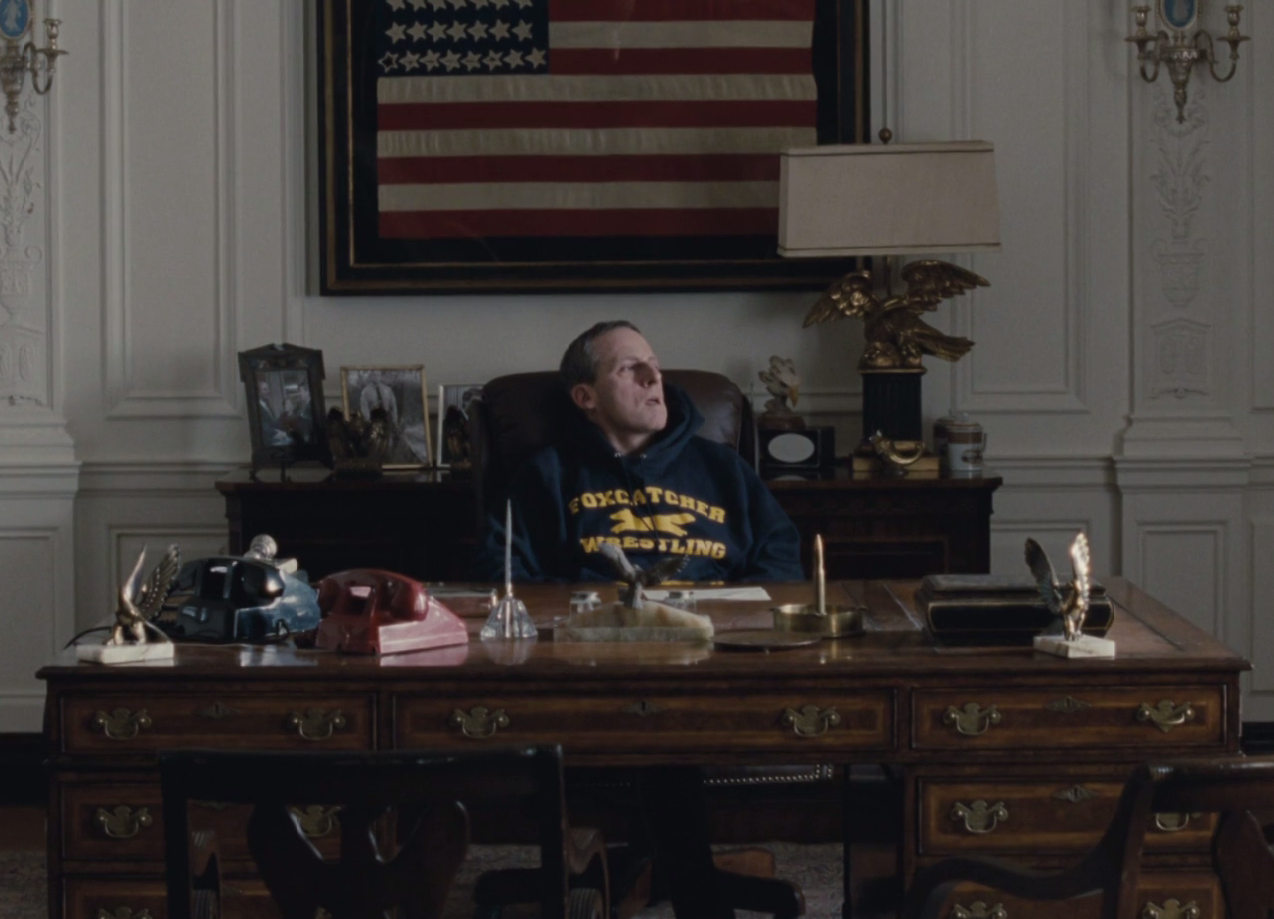
             Take Foxcatcher, Bennett Miller’s based-on-real-life story about Olympic-wrestler brothers Mark and Dave Schultz and their disturbingly wealthy benefactor, John du Pont. The movie debuted at the Cannes Film Festival in May to mostly strong reviews, and ever since then, it’s been a mainstay on award prognosticators’ lists. On one hand, taking the festival circuit route allows Foxcatcher to build up hype; voters tend to go for sure bets (i.e. what they already know they’re supposed to like), so once something cements its status as an Oscar contender, it generally remains there. But at the same time, being labeled “Oscar-worthy” comes with certain expectations. Oscar-worthy movies have prestigious actors whose roles demand some amount of yelling and/or crying. They involve more dialogue than special effects but are large enough in scope that they don’t feel “slight”. They say Important Things about Important Stuff, like slavery or the film industry, striking a comfortable balance between serious and cathartic. The earlier you put yourself out in the open, the more time people have to realize that you fail to meet those expectations and the likelier it is that the initial goodwill will fade and you’ll experience a backlash.

             It’s probably unfair to review a movie by talking about its hype and awards potential, since that says nothing about its actual quality, but I can’t deny that I went into Foxcatcher with a specific vision in my head and left feeling somewhat let down, disoriented for reasons I couldn’t quite pinpoint. The truth is, this is not an Oscar movie. Sure, it’s based on a true story and has an Oscar-nominated director at the helm, two elements that never hurt your chances. Yet despite having guided both of his previous efforts to Best Picture nominations, Bennett Miller is hardly a household name; like J.C. Chandor, another rising talent who thrives on quiet adult dramas, his style is too understated to garner the kind of devotion inspired by David Fincher and Paul Thomas Anderson. The cast is more well-liked than prestigious (of the three main actors, only Mark Ruffalo has an Oscar nomination), and although it contains not-particularly-subtle messages about the danger of American exceptionalism, this isn’t exactly Selma as far as Important Stuff goes.

Friday, November 14, 2014

Fighting the Unbearable Emptiness with Love

StarGazer

***BEWARE POSSIBLE SPOILERS***


        You’ll probably know whether or not you’re going to like Interstellar within the first half hour. The premise: a group of scientists led by Matthew McConaughey’s Cooper has been tasked with traveling into a wormhole near Saturn and finding a planet that could replace Earth, which has been so ruined it can no longer sustain human life. You either accept this – and, not to mention, all the quirks about bending space-time, hopping dimensions and corn – or you don’t. If you can’t suspend your disbelief, you’ll likely dismiss Christopher Nolan’s latest venture as maddening, self-absorbed drivel, but if you can embrace the plot as it is, you’ll be rewarded with an immersive spectacle that blends the grand scope of 2001: A Space Odyssey with the more personal sincerity of Contact, one that recalls innumerable sci-fi flicks of the past but never seems interested in trying to be anything other than itself.

        Like last year’s Gravity, Interstellar begs to be seen on as large a screen as possible, and its basic story is secondary to the mere experience of sitting and watching it. An IMAX theater viewing especially provides a sensory explosion so enveloping that it’s almost overwhelming. Boasting visual effects that, more than being just stunning to look at, actually feel real, the film serves as a sharp and more-than-welcome contrast to the blatant CGI of something like the Thor movies or the superficial, screensaver prettiness of The Tree of Life. Assisted by Hoyte van Hoytema’s elegant cinematography, the film doesn’t just present images of wormholes, distant planets and extra dimensions – it transports you to them. Jaw-dropping shots of a spaceship passing Saturn or approaching a black hole are matched by suffocating scenes set in the dust-blown fields that apparently cover future America and an almost disturbingly visceral sequence where a spacecraft gradually disintegrates into nothingness, the you-are-there sensation enhanced by some finely tuned sound editing. Composer Hans Zimmer contributes to the movie’s delicate tonal mix of grandeur and immediacy with a marvel of a score that alternates between an operatic, organ-played theme and more staccato, tense rhythms. Smartly executed on practically every technical level, Interstellar is a dizzying dream of a movie, inspiring the kind of pure awe that so many films aim for but rarely achieve.

        Yet, for all the visual fireworks, scientific jargon and Prometheus-esque philosophizing, there’s something very elemental, almost archetypal about Interstellar. The relationship between Cooper and Murph (played by both Jessica Chastain and Mackenzie Foy, who is perhaps the movie’s biggest surprise other than the Bill Irwin-voiced robot and secret MVP T.A.R.S.) anchors the narrative, even as it traverses planets, galaxies and dimensions, and resonates with an earnestness that comes off as sweet instead of sentimental. At its core, this is a story about love – not just the love between parents and children, though that’s a central focus, but the one between lovers, siblings, people and their home, humanity and itself. Helped by all-around solid performances from a recognizable cast and uncluttered by prolonged action set pieces, Christopher and Jonathan Nolan’s screenplay spends enough time with the characters to justify an emotional investment in their survival, even if some of the supporting roles could’ve been fleshed out more, a challenge for a film already approaching the three hour mark. Some of the movie’s best scenes are its simplest: a father tries in vain to comfort his distraught daughter; a heartbreaking montage of video messages; one character is so relieved to see another person, he collapses in tears. Human beings are a source of both doom and salvation in Interstellar, the latter of which proves possible only through a sense of shared community, devotion and empathy.

Tuesday, November 4, 2014

How to Get Away With Business

WordMaster


             Lou Bloom is not your usual movie sociopath. With his mane of slightly too-long hair, wiry frame and large eyes, he lacks the subtle menace of Hannibal Lecter and the slick, shallow charisma of Patrick Bateman. If anything, his tendency to aggressively spout self-help aphorisms and hackneyed corporate jargon at a mile a minute makes him seem rather dense at first, almost childlike. He starts the film as an aimless petty thief, selling wire, watches and whatever random paraphernalia he can find for a meager income, and claims to have only a high school education. For all his go-getter gusto, he doesn’t come across as particularly magnetic, competent or intimidating – he’s more Pete Campbell than Don Draper.

             And yet, it’s impossible to take your eyes off him. Naturally, a large portion of the credit must go to star Jake Gyllenhaal, who has quietly spent the past couple years undergoing one of the weirdest, most unexpected career revivals this side of Matthew McConaughey, with turns in gritty, off-kilter indies like End of Watch and Prisoners.  Here, the transformation is complete: nearly 30 pounds lighter and affecting a deadpan, higher-pitched voice, he’s virtually unrecognizable as the fresh-faced kid of October Sky, Donnie Darko and Brokeback Mountain. Such dramatic changes in appearance tend to invite hyperbole from the media, words like “fearless” and “astonishing” tossed around with the nonchalance of a baseball between innings (or, on the flip side, they’re scorned as self-serving stunts that merit neither admiration nor awards). In this case, however, any and all praise is entirely deserved. The weight loss isn’t what makes Gyllenhaal’s performance a remarkable feat of physical acting; it’s the nuances, the way he can apparently go endless amounts of time without blinking, the smile so unnervingly wide it verges on cartoonish, the minute gestures and shifts in expression that seem simultaneously meaningful and utterly. It’s electrifying in its contradictions, by turns ostentatious and controlled, raw and aloof, and as hard to pin down as the film’s protagonist.

Friday, October 10, 2014

Perfection, Deconstructed in Gone Girl

StarGazer

***SPOILER ALERT!***


         This is what marriage is supposed to look like. A man and a woman in their late 20s/early 30s – whiteness and physical compatibility optional but definitely preferred – meet, fall in love, date for a couple of years and get hitched in an elegant, classy ceremony. They move into a nice, big house with a manicured, grassy lawn and quiet, pleasant neighbors and eventually a cute kid or two comes along to complete the picture. Aside from the children, this is what Nick and Amy Dunne have. Sure, they’ve run into some money problems, and a cancerous parent forced them out of their chic New York City life and into Middle-of-Nowhere, Missouri, but they’ve still got her trust fund and, more importantly, each other. Isn’t that all anyone needs, after all? They have what everyone wants, and it’s just about perfect – until it isn’t. With a script adapted by Gillian Flynn from her own gleefully twisted, blisteringly caustic novel, David Fincher’s Gone Girl methodically chips away at manufactured ideals of justice, happiness and love to reveal the toxic, inconvenient reality underneath all the everything’s great! smiles. This, the movie says, is what marriage really is.

        Though it tones down a lot of the more explicit and scathing gender politics of its source material, Fincher’s film nonetheless feeds off of the same desire to critique both the institution of heterosexual marriage and the ease with which the media shapes (and can be used to shape) the truth. In fact, here, there is no truth, at least not a singular one and certainly not one that really matters; as another recent movie that explored the materiality of fiction said, people believe what they want to believe. So, Nick continues to believe that he’s a decent person at heart, despite all evidence to the contrary, and Amy believes she’s justified in framing him for the wrongs he’s done to her and for all he represents – for his laziness, apathy, entitlement and overt and repressed misogyny. The police, media and public believe, first, in the infuriating but predictable story of a frustrated, temperamental, cheating man who killed his wife and, later, in the comforting but equally cliché story of a traumatized, victimized woman who just wants to live in peace and to repair her strained relationship with her husband.

Wednesday, July 30, 2014

It's Moments That Seize Us

WordMaster


            When describing something like Boyhood, Richard Linklater’s attempt to capture the experience of growing up in something resembling real-time, it’s easy to toss around hyperbolic terms like “brilliant” and “tour de force” – and even easier to get swept up in them. With something this ambitious and experimental, you walk into the theater expecting your life to be altered, your mind opened to new, profound insights into the human condition, whatever that means. To tell the truth, though, Boyhood is nothing like that. Just as Terrence Malick’s The Tree of Life didn’t reveal the meaning of the universe, Boyhood doesn’t shed light on any mind-blowing secrets about coming of age in contemporary America. It is, in fact, rather ordinary.

            The boy in question, named Mason Jr. and played by neophyte actor Ellar Coltrane, is no one special. He’s white and able-bodied, gradually evolving from a fresh-faced kid into a gangly teenager with a pierced ear, possessing few exceptional qualities except a penchant for photography and moody philosophizing. The 12 years of his life covered by the film (compressed into a nearly three-hour running time, which feels surprisingly like nothing at all) contain little that could be categorized as action and follow only the ghost of a narrative structure, not rising toward a climax so much as meandering around one. Even the most ostensibly sensational events, such as Mason’s strained interactions with his two alcoholic stepfathers, are conveyed through the dispassionate gaze of a documentarian. Although it offers an intimate look at the everyday existence of its protagonist, the movie never really allows us into his head; we merely observe, never experience.

            Deprived of the visceral immediacy I had been anticipating, I couldn’t help but feel somewhat let down at first. What I thought would be a joyful celebration of youth instead turned out to be a rather depressing reminder of how boring reality is, delivered from the perspective of someone I found neither relatable nor particularly interesting (especially as an adolescent, Mason is a quintessential Linklater character: wistful, talkative, laid-back and in love with his own thoughts). Once my initial reaction faded, however, it dawned on me that I was supposed to feel that way. Boyhood isn’t about catharsis; it’s about numbing, the sinking realization that this is it, this is life, and you have no idea what to do with it.

            If that sounds like a downer, it is. Yet it’s also strangely captivating, unfurling with a dreamy, leisurely serenity that mirrors its Texas backdrop, not bowling you over with emotions so much as letting them sink into you and creep beneath your skin. Bereft of shocking revelations, turning points and anything else resembling a major plot twist, Boyhood revels in details – gestures, pop culture references, objects, places rendered with such evocative specificity it feels like you’re wandering through a memory. For example, when Mason accompanies his mother (Patricia Arquette in a performance revelatory for its quiet poignancy) to her college psychology class, he sees the professor put his hand on her back, and we instantly understand the implications of this tiny, seemingly casual act. Linklater is predominantly known for his dialogue, and to be sure, there’s plenty of it here, but he also puts on a clinic in how to impart information by showing rather than telling.

            In the hands of almost any other director, Boyhood might have ended up as little more than a curiosity, its unconventional filming style elevating a fairly conventional teen movie plot (alcohol-soaked parties? Check. Short-lived romances? Check. Heart-to-heart conversations about the future? You’re damn right check). But with his naturalistic direction and subtle script, Linklater infuses the proceedings with a sense of sincerity that most coming-of-age films lack, eschewing shallow nostalgia and familiar clichés in favor of something messier and more honest. Furthermore, anyone who dismisses the premise as a mere gimmick would be mistaken. On the contrary, it’s the entire point. Life, according to Boyhood, is basically meaningless; there’s no grand master plan, no higher purpose to the series of arbitrary benchmarks we pass on our way to death (to paraphrase Arquette in the movie’s most haunting scene). What make it all worthwhile are the little things, the fragments of time between benchmarks when you forget about the inevitability of mortality and the impermanence of things. Life is about the clear sunset that greets you after a long hike, the song you hear on the car radio, the near-infinite number of seconds that tick by as you debate whether to kiss the girl sitting next to you. It’s about the moments that are there and then, before you know it, gone.


Links:

Thursday, July 17, 2014

I, For One, Welcome Our New Ape Overlords

StarGazer


       Tragic blockbusters are fascinating. Since we as audiences have become so accustomed to summer popcorn flicks wrapping up with the hero defeating the monster, saving the world and getting the girl (because, let’s face it, the hero’s pretty much never a girl), the few that enter darker territory often seem to merit extra attention simply for their willingness to break from the long-held assumption that crowds can only be pleased by happy endings. What makes the Planet of the Apes franchise so peculiar, other than its shocking longevity, is that, as critic Matt Zoller Seitz asserts, it has always been inherently bleak. From the moment Charlton Heston laid eyes on that partially-buried Statue of Liberty at the end of the original 1968 film, humanity was doomed, and if any later additions or reiterations deviated from that pessimistic viewpoint, it would feel false, incompatible with the rest of the canon. It’s not just the apocalyptic, if rather ludicrous premise that makes these movies inevitably tragedies; it’s because, even in creating a universe where apes rule the world, they still paint humans as the ultimate monster, catalysts of their own downfall.

        Dawn of the Planet of the Apes, the latest installment to the simian-obsessed series, continues in that despairing tradition. Set ten years after 2011’s similarly awkwardly-titled Rise of the Planet of the Apes, which showed how apes became hyper-intelligent and introduced a deadly virus that quickly spread across the globe, Dawn finds civilization in shambles as a handful of survivors hole up in San Francisco, unable to connect to any other communities that could possibly have sprung up, while the group of apes led by Caesar has thrived on land that’s been reclaimed by nature. Naturally, the two societies eventually discover each other and come into explosive conflict. Given that audiences have known the conclusion to this story for nearly half a century, it would’ve been easy for both of these movies to fall into the usual prequel trap, where the predetermined outcome prevents current events from having any real weight. While most prequels make do with lazy writing that simply goes through the motions, Rupert Wyatt’s Rise presented a coherent narrative – something that’s appallingly hard to come by in modern blockbusters (talk about setting low standards) – that was not only fun to watch unfold, but also seemed interested in telling a new story, rather than merely setting up for an old one. Despite changing directors, with Let Me In’s Matt Reeves now at the helm, Dawn seamlessly transitions from and builds off of the solid foundation established by its predecessor, taking advantage of the fairly large time jump to mine different creative ground without losing the blend of epic scope and intimate focus that made Rise successful. It offers an equally thrilling, unexpectedly contemplative look at what happens when brute force triumphs over compassion, the consequences of historical violence, and the meaning of family, community and home.

Monday, June 9, 2014

In Which Tom Cruise and Emily Blunt Try to Save Hollywood

WordMaster


             Unintended metaphors stick out from Edge of Tomorrow like machine guns from clunky metal exo-skeletons. On one hand, the movie mirrors the career of its aging lead, a once-formidable superstar struggling to cling to the last vestiges of his fame and hurtling through action extravaganzas as though he wasn’t now past 50 years old. One early scene shows our hero William Cage, a spokesman and officer in the United States Army Reserve, reacting with incredulity to the news that he will be sent into combat for the first time in his military career, and it’s hard not to see that moment as tongue-in-cheek, Tom Cruise poking fun at his own cushy celebrity status. After all, though tarnished, his image is still apparently enough for studios to keep shoving tent-poles at him. He still looks as handsome and bright-eyed as ever – damn near indestructible.

             The movie could also represent the precarious position of contemporary filmmaking. We’ve all read enough think-pieces lamenting the demise of cinema and rolled our eyes in jaded exasperation at the announcement of yet another superhero reboot. Yet as clichéd and overblown as the cynicism may be, going to the theater does sometimes feel like déjà vu, a never-ending cycle of carbon-copied battles and catastrophes. We’re like Cage, throwing ourselves into the turmoil again and again, hoping that this time, it will be different, only to be continually disappointed.

             On paper, Edge of Tomorrow seems like a continuation of the same pattern, just another disposable blockbuster that will be forgotten in a week. Even the title (once upon a time the endearingly ridiculous All You Need Is Kill) screams “generic”. Yet somehow, despite the name and the hackneyed premise, it works. Of course, this being a moderately budgeted science-fiction spectacle, a decent chunk of screen-time is consumed by elaborate set-pieces involving bright lights, loud noises and quick editing. But what the action lacks in ingenuity, it makes up for in efficiency; at the very least, it makes sense and helps to advance the narrative instead of stalling, overwhelming or distracting from it. Although the plot carries echoes of numerous other movies (it’s essentially Pacific Rim crossed with Source Code), director Doug Liman has such a blast playing with the central gimmick that it doesn’t feel like a simple retread; in fact, it surpasses both of the aforementioned films, buoyed with enough humor to eschew the pompous melodrama of the former and enough energy to ward off the staid repetitiveness of the latter. The whole thing is just enough cheeky, absurd fun that you can forgive its more familiar moments and logical failings, at least until the letdown of an ending.

Wednesday, June 4, 2014

Belle Makes Gentle Case for Storytelling Diversity

StarGazer


        It’s easy to imagine a different version of Belle. Told through the eyes of Tom Wilkinson’s William Murray, the 1st Earl of Mansfield and great-uncle of the titular character, or the idealistic lawyer played by Sam Reid who falls in love with her, this alternate version positions Dido Belle Lindsay, the illegitimate daughter of a British Royal Navy officer and an African slave, as a prominent but still secondary character. Her nobility and courage inspires the people around her to overcome their prejudices and become more tolerant, showing them that people of color can be worthy of their respect. Like the actual film, this hypothetical one climaxes with Murray delivering his verdict for the famous Zong massacre insurance case, except here, his rousing speech demonstrates that he’s no longer racist, that he’s now so not racist that he’ll rule against the slave trade establishment that was so integral to 18th-century England’s economy. Characters weep tears of joy and pride, and audiences cheer, because look at that, people can change for the better, and haven’t we come so far from those days?

        Luckily, thanks to director Amma Asante and writer Misan Sagay (both of whom are black women, a true rarity for a semi-mainstream movie), that isn’t the Belle we got. To be sure, it has a feel-good buoyancy that puts it closer tonally to a frothy romantic comedy than the somber gravitas of Great Movies like, say, 12 Years a Slave, and it doesn’t upend the tropes of the costume dramas in whose footsteps it follows so much as it puts them in a new light. Yet, this film still illustrates just how much those in charge of a movie’s production influence the way a particular story is told and how something as deceptively simple as a point-of-view shift can make what would otherwise feel clichéd seem interesting again.

Sunday, April 6, 2014

At Last, a Superhero We Recognize

WordMaster


             For the sake of transparency, I’m not going to write this review under any pretense of objectivity. As I’ve made abundantly (and probably obnoxiously) evident on this blog, I have major issues with Marvel and superhero movies in general, and I had a lot of expectations riding on Captain America: The Winter Soldier, the second feature film centered on the star-spangled super-soldier. In a far-fetched way, I was in a similar position to the resurrected Steve Rogers: disillusioned and clinging to some delicate shred of hope that the future just might be brighter than the present gives us reason to believe. This movie would either restore my faith in Hollywood blockbusters or completely ruin my desire to ever pay for another superhero blockbuster.

             At first, it didn’t look promising. I could actually feel my heart sinking as Captain America and his fellow S.H.I.E.L.D. agents, including the enigmatic ex-Soviet spy Black Widow, boarded a ship to rescue hostages from Algerian pirates for an extended action sequence with no immediate purpose in terms of the overarching narrative. It turned out that the scene wasn’t superfluous, but its function only became apparent much later in the movie; as an opening set-piece, it was less than enthralling, plunging viewers into a situation without allowing them to get thoroughly (re)acquainted with the characters beforehand or informing them of the stakes involved, of why they should care. Not helping was the awkward humor, which lacked the sardonic zip we’ve come to expect from even the more subpar entries in the Avengers mega-franchise.

             Just as I started to resign myself to yet another should’ve-been-better Marvel offering, something suddenly clicked. I can’t pinpoint the precise moment my mood shifted from disappointed to thrilled, but it must have been sometime around when Robert Redford entered the picture, sporting a stark gray suit and old-fashioned spectacles as menacing S.H.I.E.L.D. official Alexander Pierce. It’s widely agreed that villains are something of a weak point for Marvel, yet even as an outspoken critic of the studio, I think that shortcoming might be overstated. After all, Tom Hiddleston’s Loki is by far the closest any other superhero antagonist has come to matching the intoxicating, compulsively watchable allure of Heath Ledger’s Joker, and even lesser baddies such as Guy Pearce’s Aldrich Killian have been elevated by forceful performances. Pierce belongs closer to the latter group. His motives and background are rather hazy, his diabolical scheme not quite holding up to close scrutiny, yet thanks to Redford, it hardly matters. With his weathered face and steely gaze, the veteran performer brings a welcome gravitas to the largely fanciful proceedings, unexpectedly resisting the impulse to chew scenery in favor of a restrained, almost world-weary iciness.


Wednesday, January 1, 2014

Finding Love in the Age of Digital Reproduction

StarGazer


        Every so often, there comes along a cinematic voice so distinctive, so brazenly talented you can’t imagine what the movie world would look like without it. Despite having only four feature-length films under his belt, Spike Jonze has made a persuasive argument that he deserves a place within that elite group, emerging as one of the best directors of the past decade. His past work has been characterized not only by its originality and a preoccupation with existential musings, but also by rare emotional sensitivity, a keen eye for the nuances of human thought and feeling, and his newest effort is no different. Unfurling like a sublime, whispered daydream, Her uses the story of a depressed, soon-to-be-divorced letter writer who develops a close relationship with his newly-acquired personal operating system to explore the thrill of falling in love, the pain of letting go, and the ways in which technology has changed how people connect with each other and understand themselves, for better or worse.

        Meet Theodore Twombly. He’s a middle-aged writer for a company that composes personal letters for people who, for whatever reason, don’t want to do it themselves. With a thick mustache covering his upper lip and a pair of large, plastic-rimmed glasses perched on his nose, Theodore displays such acuity and honest affection in his letters that a colleague (played by Parks and Recreation’s Chris Pratt, endearing as always) regularly compliments him on his work. Yet, when it comes to understanding the intricacies of his own life and relationships, he’s at a complete loss. One of the reasons his wife Catherine left him is his inability to communicate and open up about his innermost thoughts and fears. Joaquin Phoenix, his uncannily clear gray eyes constantly caught between a smile and tears, slides into the role with such apparent ease that it’s tempting to overlook just how impressive his modestly soulful performance really is. Frequently the only person occupying a scene, he carries the movie on his hunched shoulders and serves as the audience’s chief human connection to Jonze’s sleek yet distant futuristic world. The director regularly shoots him in tight close-ups, allowing us to appreciate every facet of Phoenix’s embodiment of quiet, aching loneliness. Instead of cutting himself off and wallowing in the self-pitying moodiness that too often characterizes cinematic loners, Phoenix becomes an open book and makes each thought and emotion accessible, an almost painfully relatable Everyman.

Tuesday, December 31, 2013

Smooth as a Con Artist

WordMaster


              Christian Bale squints at himself in the mirror, pasting a lump of hair onto his bare scalp with gel. We watch for what feels like five minutes as he tries to smooth it out, his dark eyebrows furrowed in concentration, a pair of rose-tinted glasses perched on his nose, in a desperate, ultimately futile attempt to hide his hideous combover. It’s a brilliant beginning to a movie obsessed with visual details. Throughout the whole thing, there’s not a single tie, earring, shade, painting or hair out of place; they all seem to meld together in an intoxicating collage of ‘70s euphoria, the bright, faintly oily cinematography courtesy of Linus Sandgren juxtaposed with a feverish, pitch-perfect dreamscape of a soundtrack that features artists as diverse as Duke Ellington and the Bee Gees.

              The plot that unfolds isn’t particularly revelatory – it’s basically a heist flick meets an Informant!-style conspiracy comedy with a dash of romance sprinkled in. But as he did with his previous two outings (underdog sports drama The Fighter and mental illness rom-com Silver Linings Playbook), newly Oscar-friendly director David O. Russell takes a traditional narrative and instills it with his own flair, his sense of bubbling energy and chaos that simmers just beneath the surface, turning it into something that feels acutely personal and distinctive. Much like the Coen brothers, he has demonstrated a remarkable ability to bounce between a variety of genres without losing touch with his unique voice. Even though his recent movies have toned down much of the idiosyncratic absurdity that defined his early work, they’re still undeniably his. American Hustle proves to be a fine showcase for Russell’s strengths, from his keen ear for the rhythm of speech and conversation (shown in the film’s witty yet naturalistic dialogue, which zips and pops off the screen like firecrackers) to his affection for the nuances of human eccentricity.