Pages

Thursday, November 27, 2014

Wrestling with Masculinity and Oscar Hype

WordMaster


             As several media commentators observed earlier this year, the blockbuster season, not too long ago confined to summer and Christmas time, has begun to swell like No-Face from Spirited Away, consuming May and April and threatening to spill over into March, November and perhaps even beyond. It’s a disconcerting trend for those of us who would like to go at least a couple months without having to hear the word “superhero”. Arguably, however, the same thing has already happened with Oscar season. Although the films themselves still usually come out sometime between October and December, thanks to festivals and a proliferating, rather dubious field of online pundits, you start seeing predictions for next year’s Oscars before this year’s ceremony even airs. This is also not a particularly good thing.

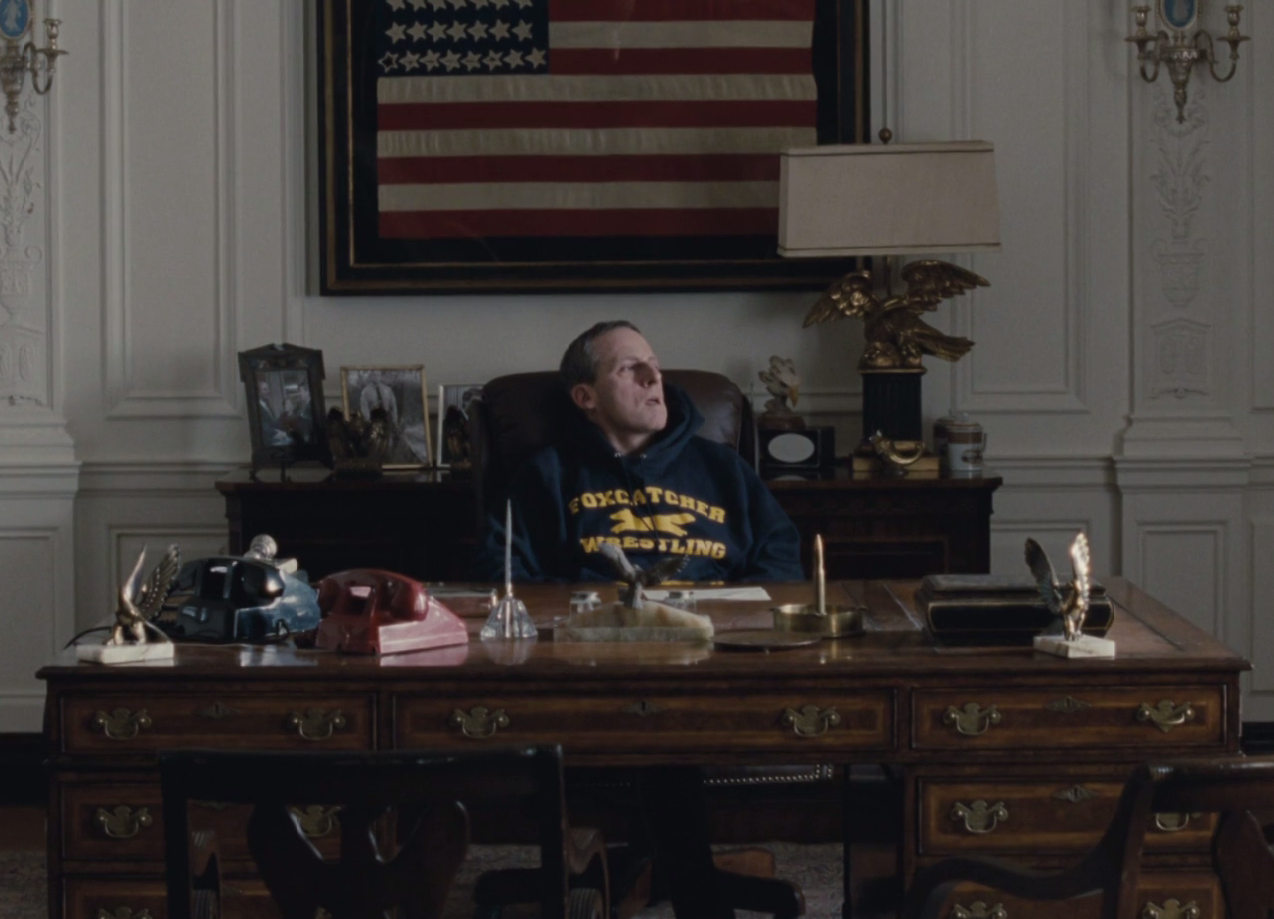
             Take Foxcatcher, Bennett Miller’s based-on-real-life story about Olympic-wrestler brothers Mark and Dave Schultz and their disturbingly wealthy benefactor, John du Pont. The movie debuted at the Cannes Film Festival in May to mostly strong reviews, and ever since then, it’s been a mainstay on award prognosticators’ lists. On one hand, taking the festival circuit route allows Foxcatcher to build up hype; voters tend to go for sure bets (i.e. what they already know they’re supposed to like), so once something cements its status as an Oscar contender, it generally remains there. But at the same time, being labeled “Oscar-worthy” comes with certain expectations. Oscar-worthy movies have prestigious actors whose roles demand some amount of yelling and/or crying. They involve more dialogue than special effects but are large enough in scope that they don’t feel “slight”. They say Important Things about Important Stuff, like slavery or the film industry, striking a comfortable balance between serious and cathartic. The earlier you put yourself out in the open, the more time people have to realize that you fail to meet those expectations and the likelier it is that the initial goodwill will fade and you’ll experience a backlash.

             It’s probably unfair to review a movie by talking about its hype and awards potential, since that says nothing about its actual quality, but I can’t deny that I went into Foxcatcher with a specific vision in my head and left feeling somewhat let down, disoriented for reasons I couldn’t quite pinpoint. The truth is, this is not an Oscar movie. Sure, it’s based on a true story and has an Oscar-nominated director at the helm, two elements that never hurt your chances. Yet despite having guided both of his previous efforts to Best Picture nominations, Bennett Miller is hardly a household name; like J.C. Chandor, another rising talent who thrives on quiet adult dramas, his style is too understated to garner the kind of devotion inspired by David Fincher and Paul Thomas Anderson. The cast is more well-liked than prestigious (of the three main actors, only Mark Ruffalo has an Oscar nomination), and although it contains not-particularly-subtle messages about the danger of American exceptionalism, this isn’t exactly Selma as far as Important Stuff goes.

Friday, November 14, 2014

Fighting the Unbearable Emptiness with Love

StarGazer

***BEWARE POSSIBLE SPOILERS***


        You’ll probably know whether or not you’re going to like Interstellar within the first half hour. The premise: a group of scientists led by Matthew McConaughey’s Cooper has been tasked with traveling into a wormhole near Saturn and finding a planet that could replace Earth, which has been so ruined it can no longer sustain human life. You either accept this – and, not to mention, all the quirks about bending space-time, hopping dimensions and corn – or you don’t. If you can’t suspend your disbelief, you’ll likely dismiss Christopher Nolan’s latest venture as maddening, self-absorbed drivel, but if you can embrace the plot as it is, you’ll be rewarded with an immersive spectacle that blends the grand scope of 2001: A Space Odyssey with the more personal sincerity of Contact, one that recalls innumerable sci-fi flicks of the past but never seems interested in trying to be anything other than itself.

        Like last year’s Gravity, Interstellar begs to be seen on as large a screen as possible, and its basic story is secondary to the mere experience of sitting and watching it. An IMAX theater viewing especially provides a sensory explosion so enveloping that it’s almost overwhelming. Boasting visual effects that, more than being just stunning to look at, actually feel real, the film serves as a sharp and more-than-welcome contrast to the blatant CGI of something like the Thor movies or the superficial, screensaver prettiness of The Tree of Life. Assisted by Hoyte van Hoytema’s elegant cinematography, the film doesn’t just present images of wormholes, distant planets and extra dimensions – it transports you to them. Jaw-dropping shots of a spaceship passing Saturn or approaching a black hole are matched by suffocating scenes set in the dust-blown fields that apparently cover future America and an almost disturbingly visceral sequence where a spacecraft gradually disintegrates into nothingness, the you-are-there sensation enhanced by some finely tuned sound editing. Composer Hans Zimmer contributes to the movie’s delicate tonal mix of grandeur and immediacy with a marvel of a score that alternates between an operatic, organ-played theme and more staccato, tense rhythms. Smartly executed on practically every technical level, Interstellar is a dizzying dream of a movie, inspiring the kind of pure awe that so many films aim for but rarely achieve.

        Yet, for all the visual fireworks, scientific jargon and Prometheus-esque philosophizing, there’s something very elemental, almost archetypal about Interstellar. The relationship between Cooper and Murph (played by both Jessica Chastain and Mackenzie Foy, who is perhaps the movie’s biggest surprise other than the Bill Irwin-voiced robot and secret MVP T.A.R.S.) anchors the narrative, even as it traverses planets, galaxies and dimensions, and resonates with an earnestness that comes off as sweet instead of sentimental. At its core, this is a story about love – not just the love between parents and children, though that’s a central focus, but the one between lovers, siblings, people and their home, humanity and itself. Helped by all-around solid performances from a recognizable cast and uncluttered by prolonged action set pieces, Christopher and Jonathan Nolan’s screenplay spends enough time with the characters to justify an emotional investment in their survival, even if some of the supporting roles could’ve been fleshed out more, a challenge for a film already approaching the three hour mark. Some of the movie’s best scenes are its simplest: a father tries in vain to comfort his distraught daughter; a heartbreaking montage of video messages; one character is so relieved to see another person, he collapses in tears. Human beings are a source of both doom and salvation in Interstellar, the latter of which proves possible only through a sense of shared community, devotion and empathy.

Tuesday, November 4, 2014

How to Get Away With Business

WordMaster


             Lou Bloom is not your usual movie sociopath. With his mane of slightly too-long hair, wiry frame and large eyes, he lacks the subtle menace of Hannibal Lecter and the slick, shallow charisma of Patrick Bateman. If anything, his tendency to aggressively spout self-help aphorisms and hackneyed corporate jargon at a mile a minute makes him seem rather dense at first, almost childlike. He starts the film as an aimless petty thief, selling wire, watches and whatever random paraphernalia he can find for a meager income, and claims to have only a high school education. For all his go-getter gusto, he doesn’t come across as particularly magnetic, competent or intimidating – he’s more Pete Campbell than Don Draper.

             And yet, it’s impossible to take your eyes off him. Naturally, a large portion of the credit must go to star Jake Gyllenhaal, who has quietly spent the past couple years undergoing one of the weirdest, most unexpected career revivals this side of Matthew McConaughey, with turns in gritty, off-kilter indies like End of Watch and Prisoners.  Here, the transformation is complete: nearly 30 pounds lighter and affecting a deadpan, higher-pitched voice, he’s virtually unrecognizable as the fresh-faced kid of October Sky, Donnie Darko and Brokeback Mountain. Such dramatic changes in appearance tend to invite hyperbole from the media, words like “fearless” and “astonishing” tossed around with the nonchalance of a baseball between innings (or, on the flip side, they’re scorned as self-serving stunts that merit neither admiration nor awards). In this case, however, any and all praise is entirely deserved. The weight loss isn’t what makes Gyllenhaal’s performance a remarkable feat of physical acting; it’s the nuances, the way he can apparently go endless amounts of time without blinking, the smile so unnervingly wide it verges on cartoonish, the minute gestures and shifts in expression that seem simultaneously meaningful and utterly. It’s electrifying in its contradictions, by turns ostentatious and controlled, raw and aloof, and as hard to pin down as the film’s protagonist.

Sunday, October 12, 2014

The Affair, The Leftovers and the Death of Normal

StarGazer


        When Showtime’s The Affair premieres tonight, much will rightly be written about its experimental approach to structure, form and point of view. In its first episode, which is actually already available online, the show dives into a tale of temptation and (potential) infidelity that unfolds like a dream or a languid summer day, its serenity punctured every so often by moments of unsettling tension.

        It’s not just the unhurried pacing or the tone, calibrated to a tricky but riveting balance between meditative and disquieting, that reminded me of The Leftovers, another premium cable show that debuted this year. It’s the way they both bury deep into their characters’ psyches, lingering in the most secretive, troubled spaces and allowing that darkness to seep out and color the world around them. Though the similarities might not continue beyond The Affair’s first episode, from what I’ve seen, both shows seem intent on wrenching their characters out of their sedate, comfortable lives and hurtling them toward an undefined yet inevitable doom.

        The Leftover’s apocalypse is a literal one. Thrown into a collective existential crisis after the sudden, random disappearance of 2 percent of the world’s population, the residents of a suburban New York town must grapple with broken families, the rise of strange cults as old belief systems are shattered and new ones take hold, and the fact that, despite all common sense and the desires of many, life insists on moving on almost as if nothing had ever happened. By contrast, the concerns of The Affair are much more down-to-earth and mundane. Noah Solloway (played by the reliably good Dominic West) lives in a spacious New York City brownstone courtesy of his snobby but filthy rich father-in-law, is contentedly married (his wife is played by Maura Tierney, so you know she’s lovely) with four children, and has recently published his first book while still enjoying his day job as a public school teacher. As Noah himself admits, it’s an idyllic existence, one so often promised to everyone by politicians, Hollywood and advertisers but that few people could ever hope to achieve. Yet, all it takes is one chance encounter with a pretty waitress named Alison Lockhart (Ruth Wilson, a revelation) for him to consider throwing it all away. This premise has been done countless times before, and without a talented and, let’s be honest, attractive cast and such ambitious writing and direction, the prospect of spending every week watching privileged people being unhappy with their privilege would’ve sounded insufferable (counterargument: Mad Men).

Friday, October 10, 2014

Perfection, Deconstructed in Gone Girl

StarGazer

***SPOILER ALERT!***


         This is what marriage is supposed to look like. A man and a woman in their late 20s/early 30s – whiteness and physical compatibility optional but definitely preferred – meet, fall in love, date for a couple of years and get hitched in an elegant, classy ceremony. They move into a nice, big house with a manicured, grassy lawn and quiet, pleasant neighbors and eventually a cute kid or two comes along to complete the picture. Aside from the children, this is what Nick and Amy Dunne have. Sure, they’ve run into some money problems, and a cancerous parent forced them out of their chic New York City life and into Middle-of-Nowhere, Missouri, but they’ve still got her trust fund and, more importantly, each other. Isn’t that all anyone needs, after all? They have what everyone wants, and it’s just about perfect – until it isn’t. With a script adapted by Gillian Flynn from her own gleefully twisted, blisteringly caustic novel, David Fincher’s Gone Girl methodically chips away at manufactured ideals of justice, happiness and love to reveal the toxic, inconvenient reality underneath all the everything’s great! smiles. This, the movie says, is what marriage really is.

        Though it tones down a lot of the more explicit and scathing gender politics of its source material, Fincher’s film nonetheless feeds off of the same desire to critique both the institution of heterosexual marriage and the ease with which the media shapes (and can be used to shape) the truth. In fact, here, there is no truth, at least not a singular one and certainly not one that really matters; as another recent movie that explored the materiality of fiction said, people believe what they want to believe. So, Nick continues to believe that he’s a decent person at heart, despite all evidence to the contrary, and Amy believes she’s justified in framing him for the wrongs he’s done to her and for all he represents – for his laziness, apathy, entitlement and overt and repressed misogyny. The police, media and public believe, first, in the infuriating but predictable story of a frustrated, temperamental, cheating man who killed his wife and, later, in the comforting but equally cliché story of a traumatized, victimized woman who just wants to live in peace and to repair her strained relationship with her husband.

Sunday, August 3, 2014

A Guide to Doing Wonder Woman Justice

StarGazer

        For someone who has barely read any comic books, I’ve spent a lot of time discussing movies based off them. If anyone were to come up to me and say that I’m not qualified to talk about comics and should therefore just stop together, I wouldn’t even put up much of an argument, but the truth is that, for anyone who’s interested in pop culture nowadays, it’s pretty much impossible to avoid talking about Marvel, DC and the like. Geek culture, whether we’re talking about comic books or Star Trek or A Song of Ice and Fire, is no longer a niche; in fact, it’s now not only mainstream, but so dominant that it has redefined the entertainment industry, shifting perceptions of what projects are capable of finding an audience and lending greater weight to pure hype and fan anticipation in marketing. While some protectiveness is understandable, given that people always feel a bit of ownership over the things they love, this expansion and diversification of audience means “original” fans need to accept that not everyone is going to approach their favorite characters and stories in the same way and that they no longer get to be the sole authorities on what works and what doesn’t. Superheroes aren’t confined to comics anymore, so why should their fans be? Frankly, if someone can’t appreciate or understand a movie without reading the source material, then the movie probably wasn’t that good to begin with.

        All of this is to say that, despite having little interest in delving into the comics they’re based on, I feel oddly fascinated by and invested in superhero films. It’s a genre exploding with exciting potential, most of which Hollywood frustratingly has yet to explore, and with characters and narratives that can reach mythological proportions,  they tap into current societal anxieties and obsessions in a way that realistic/literary drama never could. However, as cliché as the mantra has become, with great power comes great responsibility. Now that these movies have gained widespread popularity and a level of respectability, they can’t be dismissed as escapist fluff anymore, even if that attitude remains prevalent amongst both fans and critics. The stories they tell, the people they portray and the issues they’re willing to confront – and, perhaps more importantly, how they do all these things – matter.

        And that’s why, even to a comic book n00b like me, the announcement that Wonder Woman was going to be included in the upcoming Man of Steel sequel and the more recent unveilings of her casting and costume were a really big deal. It’s not just that she’s somehow never been in a live-action feature film before, despite being one of the most iconic superheroes ever. As a well-known female superhero, that rarest of entities, she has the power to singlehandedly either transform the comic book movie industry by convincing studios and creators to finally take the women in the audience seriously or indefinitely shut down any chance we have of improving female representation in blockbusters. Fairly or not, Batman V. Superman: Dawn of Justice will essentially sink or swim based on its portrayal of Diana.


Wonder Woman preparing to stab whoever thought of that movie title

Friday, August 1, 2014

The Leftovers and Staring into the Abyss

WordMaster

            The Leftovers is not feel-good television. Initial reviews described HBO’s new drama as “some of the most desolate, despairing television on air”, “like a French arthouse series, but sadder” and “a show that will make some of its viewers want to slit their wrists” – and those are the positive ones. Perhaps realizing that waxing poetic about a show’s potential to rouse thoughts of suicide isn’t the most effective strategy for convincing people to watch it, many of these critics go out of their way to point out that The Leftovers “isn’t for everyone,” a qualification that seems not only unnecessary (nothing is “for everyone”) but also counterintuitive. If you like a piece of art, why discourage others from giving it a shot? Since when were critics responsible for accommodating audience opinions rather than simply articulating and trusting their own?

            More to the point, though, framing the show’s sorrowful mood as a caveat is like saying, “Mad Men is good, but there’s so much talking”. You’re disowning something essential to the work in question, turning its greatest strength into a negative. Precisely what gives The Leftovers its power is its commitment to exploring human emotions in all their raw messiness, its refusal to settle for false uplift and easy answers. To be sure, some people may find it too unpleasant to watch, and that’s fair enough, but for me (and, judging by the reviews, many others), it’s not a ponderous, soul-crushing exercise in mental fortitude so much as a pitch-perfect falsetto, hitting that elusive sweet note with such exquisite precision it stings. In it, I found something I hadn’t known I was yearning for: a complex, heartfelt portrait of loss.

The moment I fell in love